
The most common background screening pitfalls are having no written policy, starting checks too late, treating consent as a formality, using one template for every role, relying on a single check, choosing a vendor on price, accepting poor candidate data, treating red flags as verdicts, mishandling candidate data, and never reviewing the process. Each is avoidable with a clear, consistent and well-documented approach.
Most employers know they should verify candidates. Fewer realise that the way they verify matters just as much as whether they verify. A rushed, inconsistent or poorly documented check can miss real problems, delay good hires and create avoidable legal and reputational exposure. This guide walks through the most common pitfalls in background screening in India and shows how to avoid each one. Good background screening in India is consistent, proportionate and well documented.
Why Does Every Background Screening Pitfall Matter?
Every background screening pitfall matters because it weakens the very protection verification is meant to provide. A flawed process can give false comfort, which is arguably worse than no process at all.
When screening goes wrong, the consequences are practical. A fabricated degree slips through. A genuine candidate is rejected over a clerical error. An audit asks how a decision was made and nobody can answer. Understanding each background screening pitfall helps HR and compliance teams build a process that is accurate, fair and defensible.
What Happens When You Have No Written Screening Policy?
Without a written policy, screening becomes inconsistent. Different recruiters check different things, decisions vary from case to case, and nothing is easy to defend later.
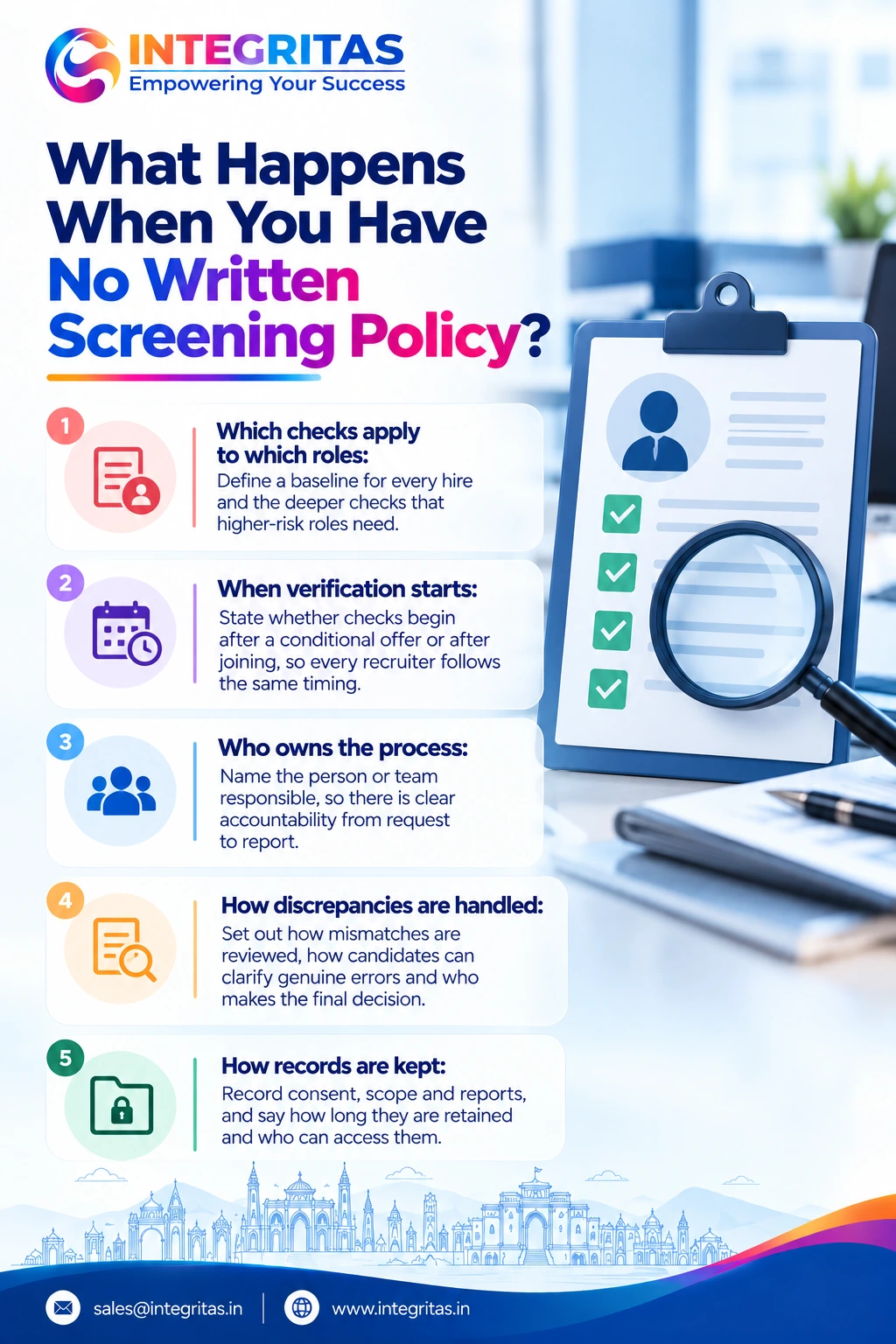
This is one of the most common background screening pitfalls in growing companies. A short policy is enough, as long as it covers these five points:
- Which checks apply to which roles: define a baseline for every hire and the deeper checks that higher-risk roles need.
- When verification starts: state whether checks begin after a conditional offer or after joining, so every recruiter follows the same timing.
- Who owns the process: name the person or team responsible, so there is clear accountability from request to report.
- How discrepancies are handled: set out how mismatches are reviewed, how candidates can clarify genuine errors and who makes the final decision.
- How records are kept: record consent, scope and reports, and say how long they are retained and who can access them.
Apply the policy to every hire, from entry level to leadership, so there are no blind spots.
What Happens When You Have No Written Screening Policy?
Without a written policy, screening becomes inconsistent. Different recruiters check different things, decisions vary from case to case, and nothing is easy to defend later.
This is one of the most common background screening pitfalls in growing companies. A short policy is enough: which checks apply to which roles, when verification starts, who owns it, how discrepancies are handled and how records are kept. Apply it to every hire, from entry level to leadership.
Why Is Starting Checks Too Late a Costly Pitfall?
Starting verification after the joining date puts pressure on everyone. Once a person has joined, rejecting them is harder, and the organisation is exposed while results are pending.
The safer approach is to begin after a conditional offer and before joining. In fast-moving hiring, post-joining checks are sometimes used, but the offer letter should then state clearly that employment is subject to satisfactory verification. Whichever model you choose, be consistent and communicate it to candidates upfront.
What Goes Wrong When Consent Is Treated as a Formality?
When consent is treated as a formality, candidates may not understand which checks will run or why, and the employer may lack proof of authorisation. That is both a trust issue and a compliance risk.
A sound process tells candidates clearly what will be verified, obtains their authorisation before starting and records it. This is a basic principle of responsible BGV, and it aligns with expectations under India’s Digital Personal Data Protection (DPDP) Act around consent and personal data.
Is a One-Size-Fits-All Approach a Background Screening Pitfall?
Yes. Applying the same package to every role either over-checks low-risk roles, which slows hiring, or under-checks high-risk roles, which increases exposure.
A finance head with payment authority, a software engineer with access to client data and a warehouse associate do not carry the same risk. A risk-based approach sets a consistent baseline, typically identity, employment, education, address and criminal checks, and adds deeper checks such as reference, credit, global database or dual employment where the role justifies them. Proportionate screening is faster, fairer and easier to defend.
Why Is Relying on a Single Check Risky?
Relying on a single check gives a partial picture. Fraud rarely shows up in just one place, so one clean result can hide problems elsewhere.
An employment check may confirm that a person worked at a company, an education check may confirm a qualification, and an identity check may confirm the records belong to the same individual. Looking at them together reveals inconsistencies no single check would. Scanned documents alone are another version of this background screening pitfall: a certificate that looks genuine can still be altered, which is why verification should go to the issuing source.
What Is the Risk of Choosing a Vendor on Price Alone?
Choosing on price alone often means rushed research, thin reporting and missed discrepancies. A low fee is no bargain if the report fails to catch the problem you hired the vendor to find.
When comparing providers, look beyond the quote. The best background check company for your needs is one that explains its process clearly, covers the checks you need, applies independent quality review, reports with context and handles data responsibly. Choosing the best background check company starts with asking for a sample report, a process walkthrough and, if possible, a small pilot with two shortlisted providers on the same candidates.
How Does Poor Candidate Data Cause Delays?
Incomplete or incorrect candidate data is among the most frequent causes of delay. A misspelt name, wrong date or missing document can stall a check or lead to a false mismatch.
Prevent this by asking candidates to submit complete details and supporting documents upfront, reviewing them before research starts and giving clear guidance on what is needed.
Should a Red Flag Be Treated as a Verdict?
No. A mismatch is a reason for further review, not automatic proof of fraud. Treating every flag as a verdict is a serious background screening pitfall that can wrongly cost good candidates their jobs.
Differences in employment dates, titles that cannot be confirmed or education details that do not match records can come from clerical errors, name variations, closed companies or slow-responding sources, as well as from deliberate misrepresentation. A fair process reviews the finding in context, cross-checks it against other results, gives candidates a chance to clarify genuine errors and documents anything unresolved. Criminal and court records in particular need careful, lawful interpretation, since a database entry does not automatically make a candidate unsuitable.
Why Do Data Protection Lapses Matter?
Verification involves sensitive personal information. Sharing it over unsecured channels, keeping it longer than needed or using it for unrelated purposes can harm candidates and expose the employer.
Good practice means collecting only what the verification requires, using it only for that purpose, storing it securely and disposing of it appropriately. Ask any BGV partner how they handle consent, access, storage and disposal.
What Happens When Screening Is Never Reviewed?
Roles, regulations and risks change, so a screening policy that was right two years ago may no longer fit. An unreviewed process slowly drifts out of date.
Review your background screening in India policy at least once a year, and whenever you enter a regulated sector, open new locations or change hiring volumes. Consider re-verification when an employee moves into a role with greater financial or data access.
How Does Integritas Help You Avoid Every Background Screening Pitfall?
Integritas helps employers avoid each background screening pitfall through a structured six-stage process, role-based scoping, independent quality review and consent-led practices. Integritas has delivered background verification services since 2017 and treats every report as only as good as the process behind it.
Our Six-Stage BGV Process
Data Entry
The data entry team adds candidate details into the BGV portal, based on information submitted by the client and candidate.
Verify Data Entry
Client account managers review the details to confirm accuracy before the file moves to research.
Research on Data
Trained researchers authenticate documents and information through multiple independent, authorised sources.
Review of Research
Quality control managers cross-verify the findings and flag discrepancies for further action.
Final Report Preparation
A report is compiled for each candidate around the parameters the client requested, with discrepancies clearly noted.
Report Delivery
The completed report is shared with the client, with context on any red flags, variations or unverifiable claims.
Checks Offered by Integritas
Identity verification
Employment verification
Education verification
Address verification
Confirms that the candidate lives at the stated current or permanent address, usually through a physical visit or digital methods. It helps keep contact records reliable and flags false residence details.
Criminal history check
Reference check
Speaks to professional referees, usually former managers or colleagues, about the candidate’s performance, conduct and working style. It adds the human context that documents cannot show.
Global database check
Credit check
Dual employment check
Gap and UAN check
Resume verification
Social media check
Drug test screening
How This Maps to the Pitfalls
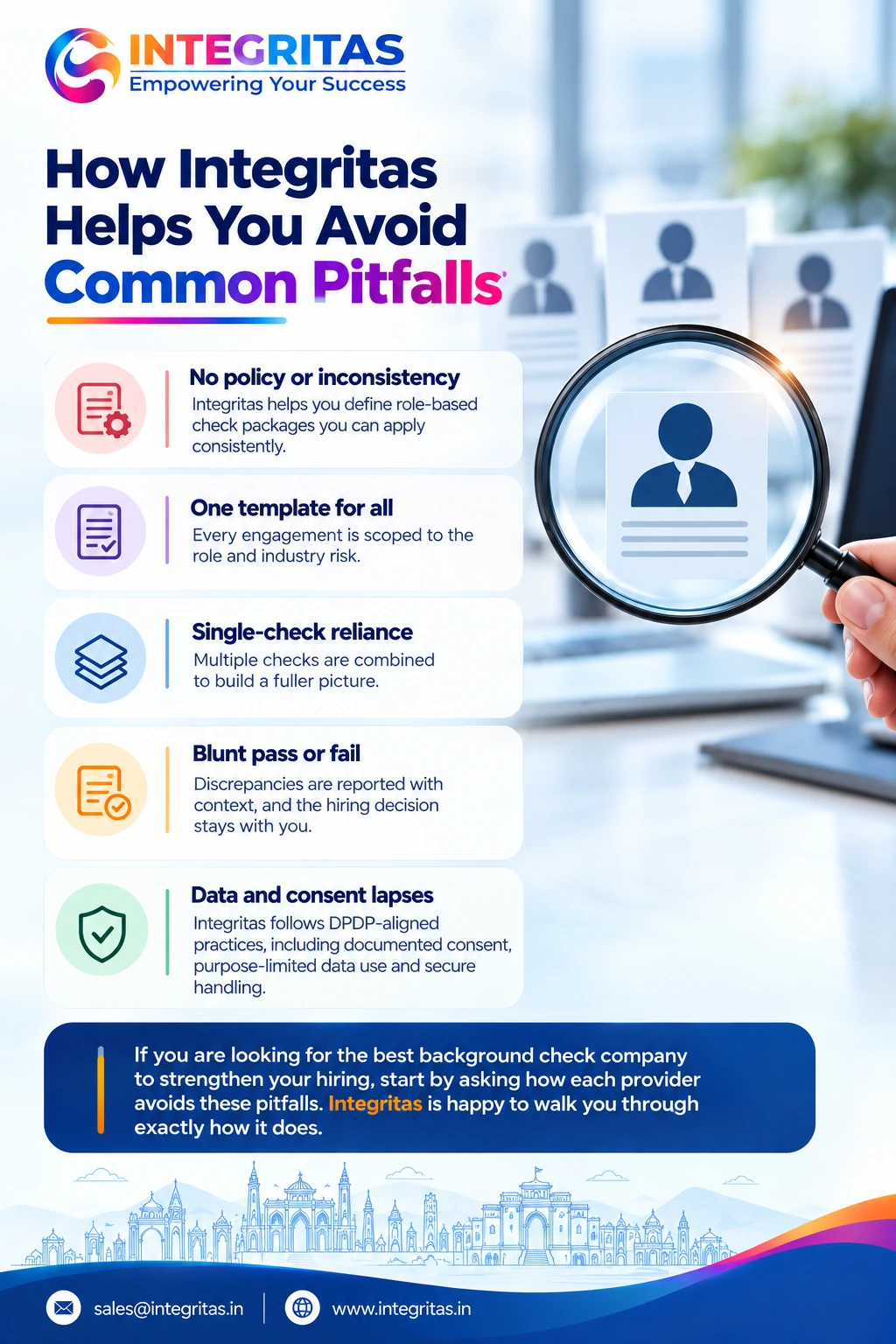
- No policy or inconsistency: Integritas helps you define role-based check packages that you can apply the same way to every hire. Instead of leaving each recruiter to decide what to verify, you get a clear baseline for every role and deeper checks for higher-risk ones. This keeps decisions consistent and easy to explain during an internal review or client audit.
- One template for all: Every engagement is scoped to the role and industry risk. A field role, a software engineer and a finance head do not need the same package, so Integritas matches the checks to the position. This avoids slowing down low-risk hiring with unnecessary checks and avoids leaving high-risk roles under-checked.
- Single-check reliance: Multiple checks are combined to build a fuller picture. Identity, employment, education, address and other checks each confirm a different part of a candidate’s background. When they are read together, inconsistencies that one check alone would miss become much easier to spot.
- Blunt pass or fail: Discrepancies are reported with context, and the hiring decision stays with you. A report explains what was found, what matched and what could not be verified, so HR can tell a clerical error from real misrepresentation. This helps you treat a red flag as a reason for review, not as an automatic verdict.
- Data and consent lapses: Integritas follows DPDP-aligned practices, including documented consent, purpose-limited data use and secure handling. Candidates are told which checks will run, their authorisation is recorded, and their information is used only for the verification purpose. This protects candidates and gives your organisation a clear record of how data was handled.
If you are looking for the best background check company to strengthen your hiring, start by asking how each provider avoids these pitfalls. Integritas is happy to walk you through exactly how it does.
Ready to Build a Pitfall-Free Screening Process? Talk to Integritas about a background verification process designed around your roles, industry and risk profile.
FAQ’s
What is the biggest background screening pitfall?
There is no single biggest one, but inconsistent application is among the most damaging. Verifying only some roles or skipping checks under time pressure leaves blind spots and makes decisions hard to defend.
How can I avoid a background screening pitfall during fast hiring?
Start verification after a conditional offer, collect complete candidate data upfront, and use a clear scoped package for each role. If you must verify after joining, state it in the offer letter.
Is background screening in India mandatory for all employees?
It is not mandatory for every role by law, but many employers apply a consistent baseline across all hiring levels, and some sectors and clients expect it. Confirm sector-specific requirements with your legal team.
What should I look for in the best background check company in India?
A clear staged process, the full range of checks, independent quality review, contextual reporting, responsible data handling and responsive support. Ask for a sample report before deciding.
Can a mismatch in BGV be a genuine mistake?
Yes. Clerical errors, name variations, closed companies and slow sources can all cause mismatches. Review in context and let candidates clarify before deciding.
Do all roles need the same BGV checks?
No, A risk-based approach works best: a consistent baseline for every hire, with deeper checks for roles involving finance, sensitive data or regulatory exposure.
How often should I review my screening policy?
At least once a year, and whenever your hiring, locations, sector or regulations change.