
A resume is a candidate’s own account of their career. Job titles, joining dates, salary figures, and reasons for leaving all come from the candidate, and not every detail is presented with complete accuracy. As hiring in India becomes faster and more competitive, employers cannot rely on self-reported work history alone. This is where employment verification becomes essential.
Employment verification is the process of confirming that a candidate actually worked where they say they did, in the role they claim, and for the period they mention. Done well, employment verification protects the organisation from avoidable hiring risk and gives HR teams a factual basis for making offers. This guide explains what employment verification covers, what employers should check, how the process works, which red flags to watch for, and how to build it into employee onboarding and your wider employee screening programme.
What Is Employment Verification?
Employment verification, a key form of employee verification, is a background check that validates a candidate’s professional history with their previous employers. It is a core part of employee verification, sitting alongside identity, education, address, and criminal record checks. While an interview shows how a candidate presents themselves, employment verification shows whether the experience they describe is documented and consistent with employer records.
In simple terms, it answers a few basic questions. Did the candidate work at the organisation named? Was the designation accurate? Do the joining and exit dates match? Did the candidate leave on record-supported terms? These answers help HR teams separate a genuine, well-documented career from one that has been stretched, polished, or reshaped.
Why Employment Verification Matters for Employers
Every hire shapes team performance, client trust, and workplace culture. Yet interviews and skill assessments were never designed to confirm a career history. A confident candidate can describe a role they never held, and a well-formatted resume can hide gaps or overlaps. Employment verification closes this gap by checking claims against the records of the employer who knows the candidate’s work best.
- It reduces hiring risk: Misrepresented experience can lead to poor job performance, weak team fit, and expensive rehiring. Verifying work history before the offer is finalised helps employers avoid mismatches that only become visible months later.
- It supports fair, fact-based decisions: When every shortlisted candidate goes through the same employment verification, hiring decisions rest on documented facts rather than impressions.
- It matters more for sensitive roles: In positions involving finance, client data, leadership responsibility, or regulated activity, an unverified career history can create serious operational and reputational exposure. Employers in these areas often extend employee screening to cover deeper employment checks.
What Employers Should Check During Employment Verification
A thorough employment verification review goes beyond asking whether a candidate “worked there.” These are the key points employers should confirm.
1. Employer Name and Existence
Confirm that the company named on the resume is a real, operating (or previously operating) organisation. Fake or untraceable employers are a common way of inflating experience, and a basic company check can quickly expose them.
2. Designation and Role
Verify the job title held and, where relevant, the level of responsibility. A candidate who claims to have been a manager when the records show an executive role presents a very different hiring picture, even if the dates are correct.
3. Dates of Employment
Check the joining date and last working day. Small date differences may be clerical, but larger differences can signal an attempt to hide a short stint, an overlap, or a gap. Precise dates are also important for calculating total relevant experience.
4. Employment Type
Confirm whether the candidate was a full-time employee, contract worker, consultant, trainee, or intern. Experience gained in different capacities may carry different weight for the role you are hiring for.
5. Reason for Leaving
Ask the previous employer to confirm how the association ended, whether through resignation, termination, contract completion, or another reason. This is often the most sensitive part of employment verification, so it should be handled factually and without assumptions.
6. Last Drawn Salary or CTC, Where Applicable
Where the role and company policy allow, employers may verify compensation details to ensure that salary claims are consistent with records. This helps in fair offer negotiation and prevents inflated figures from influencing the offer.
7. UAN and Provident Fund History
In India, the Universal Account Number (UAN) linked to the Employees’ Provident Fund offers a useful way to cross-check a candidate’s employment trail, including the organisations they contributed through and the approximate periods. A UAN review can highlight employers or timelines that do not match the resume.
8. Employment Gaps
Unexplained gaps are not automatically a problem, since people take breaks for study, health, family, or relocation. The aim is not to penalise gaps but to identify them, ask the candidate for context, and make sure the explanation is consistent with the records.
9. Dual Employment
Working with two employers at the same time may conflict with contracts, confidentiality terms, or role expectations. A dual employment check helps employers understand whether a candidate’s commitments overlap with their current or previous roles.
How the Employment Verification Process Works
A reliable employment verification process typically follows a clear sequence.
Candidate consent and details:
The process begins with written consent from the candidate and the collection of employment details, such as company names, designations, dates, and supporting documents like offer letters, relieving letters, experience letters, and payslips.
Data validation
The submitted information is reviewed for completeness and internal consistency. Errors in spellings, dates, or company names are corrected early so that they do not delay the check.
Contacting the previous employer
A verification request is sent to the HR department or an authorised contact at the previous organisation. The employer is asked to confirm the key details against its records. Where necessary, additional reference points are used.
Cross-checking supporting sources
Any mismatch is reviewed and categorised, for example as a minor data variation, an unverifiable record, or a significant discrepancy that needs further clarification from the candidate.
Reviewing discrepancies
Any mismatch is reviewed and categorised, for example as a minor data variation, an unverifiable record, or a significant discrepancy that needs further clarification from the candidate.
Reporting
A structured report is shared with the employer, clearly showing what was verified, what could not be verified, and where discrepancies were found, so HR teams can decide the next step with confidence.
Common Red Flags in Employment Verification
Certain patterns deserve a closer look during employment verification. None of them proves wrongdoing on its own, but they justify further review.
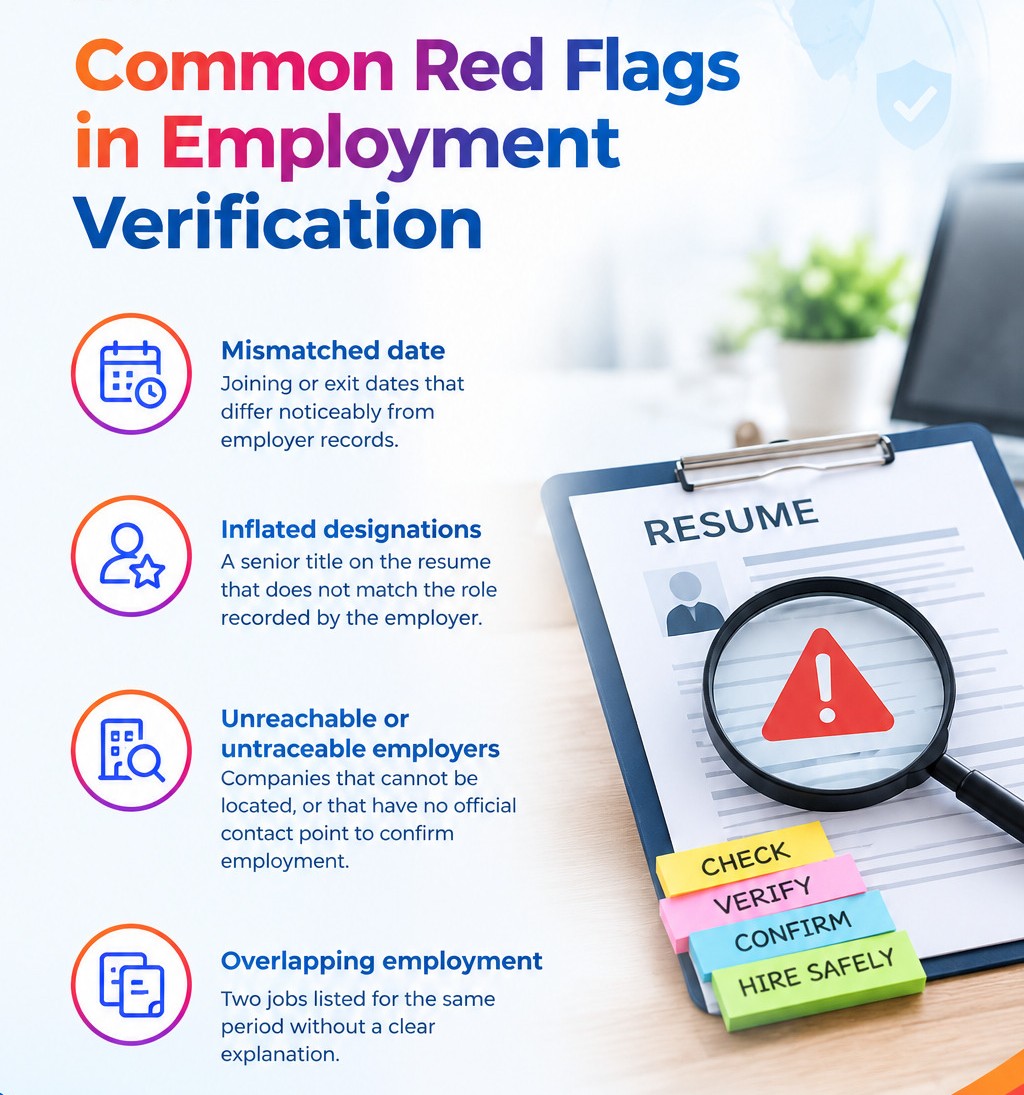
- Mismatched date: Joining or exit dates that differ noticeably from employer records.
- Inflated designations: A senior title on the resume that does not match the role recorded by the employer.
- Unreachable or untraceable employers: Companies that cannot be located, or that have no official contact point to confirm employment.
- Overlapping employment: Two jobs listed for the same period without a clear explanation.
When a red flag appears, the fair approach is to give the candidate a chance to clarify before drawing conclusions. A genuine clerical error should not cost a qualified person the opportunity.
That said, how a candidate responds to a red flag often matters as much as the flag itself. A clear, consistent explanation backed by documents a relieving letter, salary slips, or an HR email usually resolves the issue quickly. Vague answers, shifting stories, or an unwillingness to provide supporting proof are worth noting separately, since they say more about honesty than the original discrepancy did.
One mismatched date is often a simple mistake. But a candidate with mismatched dates, an inflated title, and an employer that cannot be traced is a different case altogether the pattern itself becomes the signal, even if each point alone seems minor.
Common Challenges in Employment Verification in India
Even experienced HR teams run into practical difficulties while completing employment verification in India.
- Slow or unresponsive previous employers: Some organisations take time to respond, or have no dedicated process for verification requests.
- Closed or merged companies: When a former employer has shut down, been acquired, or changed its name, records become harder to trace and alternative proof is needed.
- Informal or small-scale employment: Startups, small businesses, and contract roles may not maintain formal HR records, which makes confirmation harder.
These challenges are exactly why employers benefit from a structured, experienced approach to employee verification. A trained team knows how to follow up, which alternative sources are reliable, and how to report an unverifiable result without misrepresenting it.
Employment Verification and Employee Onboarding
Employee onboarding is where hiring risk and employee experience meet. If verification is left until after a candidate has joined, HR may face uncomfortable decisions about someone already inducted into the team. Building employment verification into the employee onboarding workflow keeps the process orderly and fair.
Start after the conditional offer: The most practical time to begin employment verification is right after a conditional offer is extended and accepted. The offer can state that it is subject to satisfactory verification of the candidate’s credentials.
Collect documents early: Ask for offer letters, relieving letters, experience letters, and payslips as part of the pre-joining checklist. Complete documentation at the start of employee onboarding reduces delays later.
Communicate clearly: Explain to candidates what will be checked, why, and how long it will take. Transparency builds trust during employee onboarding and reduces anxiety.
A smooth link between verification and employee onboarding also improves the candidate experience. Candidates who understand the process are more likely to cooperate, respond quickly, and feel confident about joining an organisation that takes hiring seriously.
Best Practices for Employee Screening
Employment verification works best when it is part of a consistent employee screening policy rather than an occasional, ad hoc step.
- Apply the policy consistently: Use the same checks for every candidate in a given role category. Consistency keeps employee screening fair and defensible.
- Match checks to the role: A junior operations role and a senior finance role do not need identical screening depth. Define which checks apply to each level, and increase the scope for higher-risk positions.
- Always obtain consent: Written consent from the candidate should precede any verification activity, and the purpose of the check should be clearly explained.
- Give candidates a chance to respond: If a discrepancy is found, allow the candidate to explain or provide additional documents before making a decision.
- Use a trusted verification partner: Working with an experienced provider of employee verification helps employers handle volume, maintain quality, and get clear, documented results.
How Integritas Supports Employment Verification for Employers
At Integritas, employment verification is handled as a structured, multi-step process rather than a quick phone call. Our team collects and validates candidate details, contacts previous employers directly, cross-checks supporting sources, and reviews discrepancies with context before sharing a final report.
Our employee verification services include:
- Employment verification, covering employer, designation, dates, and reason for leaving
- UAN and provident fund checks to cross-check employment history
- Dual employment checks to identify overlapping commitments
- Education and employment gap checks to highlight unexplained timelines
- Reference checks with previous employers or professional contacts
- Identity, address, education, and criminal record checks for complete employee screening
- Employer-ready reports that clearly show verified, unverifiable, and discrepant items
Whether you are hiring for a single leadership role or managing employee onboarding across large volumes, our team scopes the verification to match the risk and requirements of each position, so you receive accurate, well-documented results you can act on with confidence.
FAQ’s
What does a Background Verification Company in Ahmedabad usually check?
Most companies check identity, education, past employment, and address as a base. Extra checks like criminal record, credit, or global database checks are added based on the role.
How long does BGV in Ahmedabad usually take?
It depends on the number of checks and how fast past employers or colleges respond, but a good provider will give a clear expected timeline before starting.
Is candidate consent required for background verification in Ahmedabad?
Yes, Consent is required by law. A proper Background Verification Company in Ahmedabad will always ask for the candidate’s permission before starting any check, and this rule applies to every form of BGV in Ahmedabad, big or small.
Why should I choose the BGV company in Ahmedabad instead of doing checks myself?
Doing checks yourself takes time and can miss important details. The best BGV company in Ahmedabad has trained staff, verified sources, and a proper process, which gives more accurate results, faster.
Do Integritas follow DPDP Act rules during background verification in Ahmedabad?
Yes, Integritas follows DPDP-aligned practices, including proper consent, limited use of data, and secure storage, throughout every check. This is a standard part of how we run background verification in Ahmedabad for every client.