
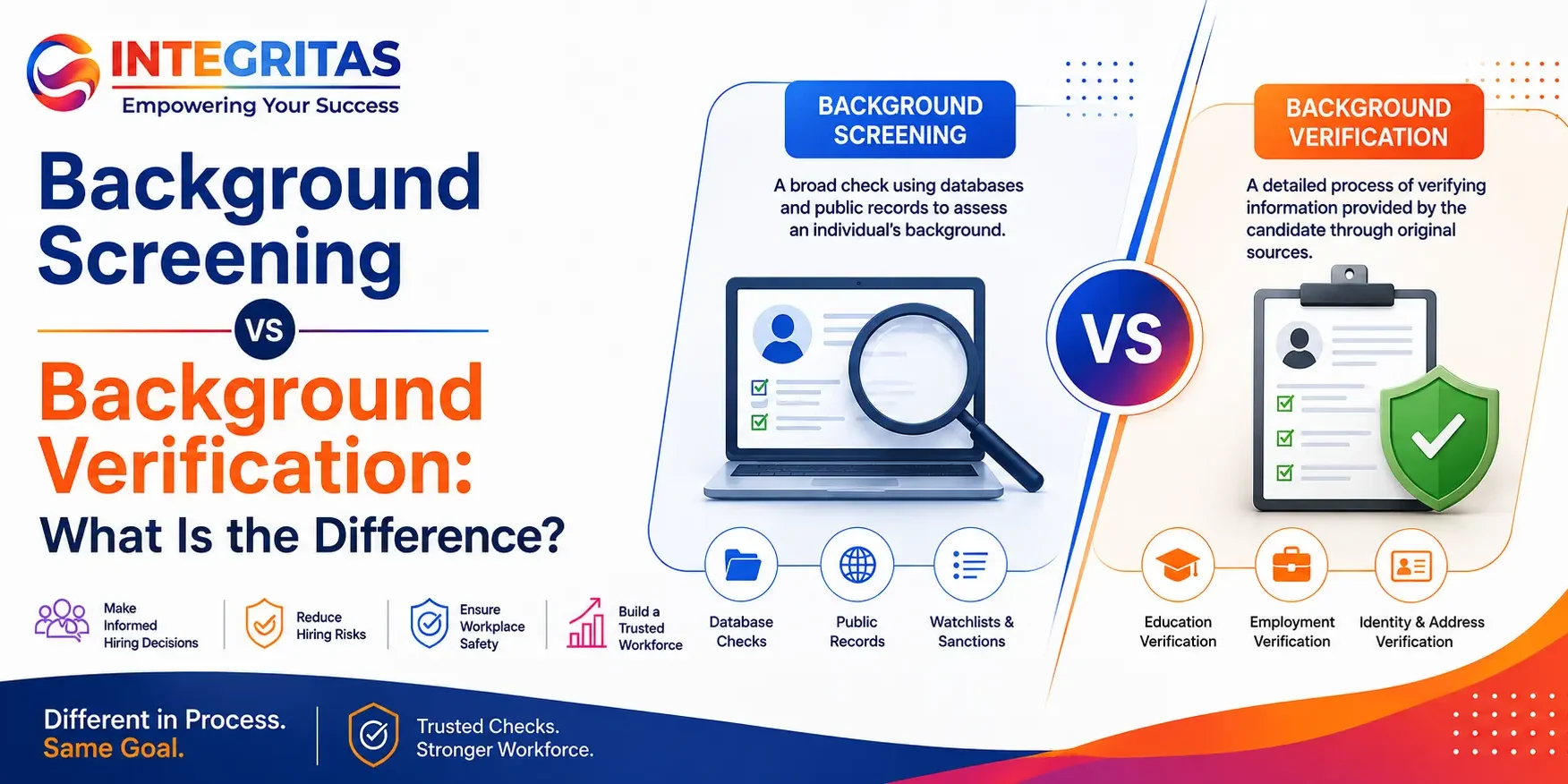
Hiring in India has changed faster in the last two years than in the previous decade. Digital-first recruitment, remote onboarding, and AI-generated resumes have made it easier than ever for candidates to present information that looks credible but isn’t always accurate. Industry estimates suggest that over 1/3rd of resumes in India contain some form of discrepancy, ranging from inflated job titles to fabricated qualifications. Against this backdrop, HR and compliance teams increasingly ask the same question: what exactly is the difference between background screenings vs verification, and does it actually matter?
The two terms are often used interchangeably, and in casual conversation, that’s usually harmless. But for HR leaders building a defensible, audit-ready hiring process, and for compliance teams answerable to regulators under India’s Digital Personal Data Protection (DPDP) Act, the distinction is worth understanding properly. This article breaks down what each term means, how they relate to one another, why the difference matters in practice, and what a strong verification partner should bring to the table in 2026.

What Is Background Screenings?
Background screenings is the complete due-diligence framework an employer runs before and around a hiring decision. It is the umbrella process — the policy, the scope, and the set of checks an organisation applies to a candidate based on the role, the industry, and applicable regulatory requirements.
A background screenings programme is typically built around the level of risk a role carries. A finance role handling client funds will trigger a different background screenings scope than an entry-level operations role.
Common Background screenings includes:
- Identity verification
- Employment history verification
- Educational qualification verification
- Address verification
- Professional reference checks
- Criminal record checks, conducted lawfully and where permitted
- Court and litigation record checks, where relevant to the role
- Global database and sanctions screening for regulated or client-facing roles
- Credit or financial checks for roles involving monetary responsibility
- Social media and public-conduct screening, limited to publicly available information
What Is Background Verification?
Background verification is the execution layer beneath background screenings. It refers to the specific act of confirming that a piece of information a candidate has provided is true, current, and matches an authoritative source.
For example, if a candidate states they worked at a company between 2021 and 2024, employment verification involves reaching out to that employer, an authorised HR contact, or a verified database such as UAN (Universal Account Number) records to confirm the dates, designation, and reason for leaving. Similarly, education verification means confirming a degree directly with the issuing university or a recognised accreditation body, not simply reviewing a scanned certificate.
Background Screenings vs Verification
| Background Screenings | Background Verification |
| The broader, policy-level due-diligence framework | The specific, execution-level validation process |
| Determines which checks apply to a role | Confirms whether specific candidate-provided facts are accurate |
| Can include multiple verification types, plus risk assessment | Usually limited to one data point at a time (e.g., one past employer) |
| Scope is customised by role, industry, and regulatory exposure | Method is dictated by the type of information being confirmed |
| Outcome: an overall risk profile for the hiring decision | Outcome: a confirmed or flagged status for one specific claim |
There is no background screenings vs verification, Both are essential. A background screenings programme without proper verification is just a checklist with no substance behind it. Verification without a defined screening scope, on the other hand, risks becoming inconsistent .

Importance of Background screenings?
For most of the last decade, background checks were treated as an HR formality, but nowadays that has changed. In 2026, background screenings vs verification sit at the intersection of HR, compliance, legal, and risk functions, particularly for organisations that hire at scale or serve regulated or global clients.
- It sharpens accountability. When HR and compliance teams use precise language, it is easier to define who owns what. A screening policy is typically owned by HR and compliance leadership; verification execution is usually delegated to a specialised partner. Blurring the two makes audits and internal reviews harder to conduct cleanly.
- It reduces hiring risk more effectively. A role-based screening scope, backed by rigorous verification of each data point, catches more than a generic, one-size-fits-all check ever could. This is particularly relevant given how common resume discrepancies have become across Indian hiring markets.
- It protects the organisation’s reputation. Employees represent the brand they work for. A single bad hire with a fabricated credential or an undisclosed conflict of interest can create reputational damage that outlasts the hire itself.
- It supports better, faster hiring decisions. When screening scope and verification depth are clearly matched to role risk, HR teams avoid two common failure modes: over-checking low-risk roles (which slows down hiring) and under-checking high-risk roles (which increases exposure).
- It strengthens regulatory and contractual compliance. Under the DPDP Act, organisations processing candidate personal data are expected to do so lawfully, with clear consent, defined purpose, and appropriate safeguards. Certain sectors — BFSI, healthcare, and IT/ITES in particular — also carry sector-specific due-diligence obligations. A well-documented screening-and-verification process makes it far easier to demonstrate compliance if ever questioned.
Common Types of Checks Under a Background Verification Programme
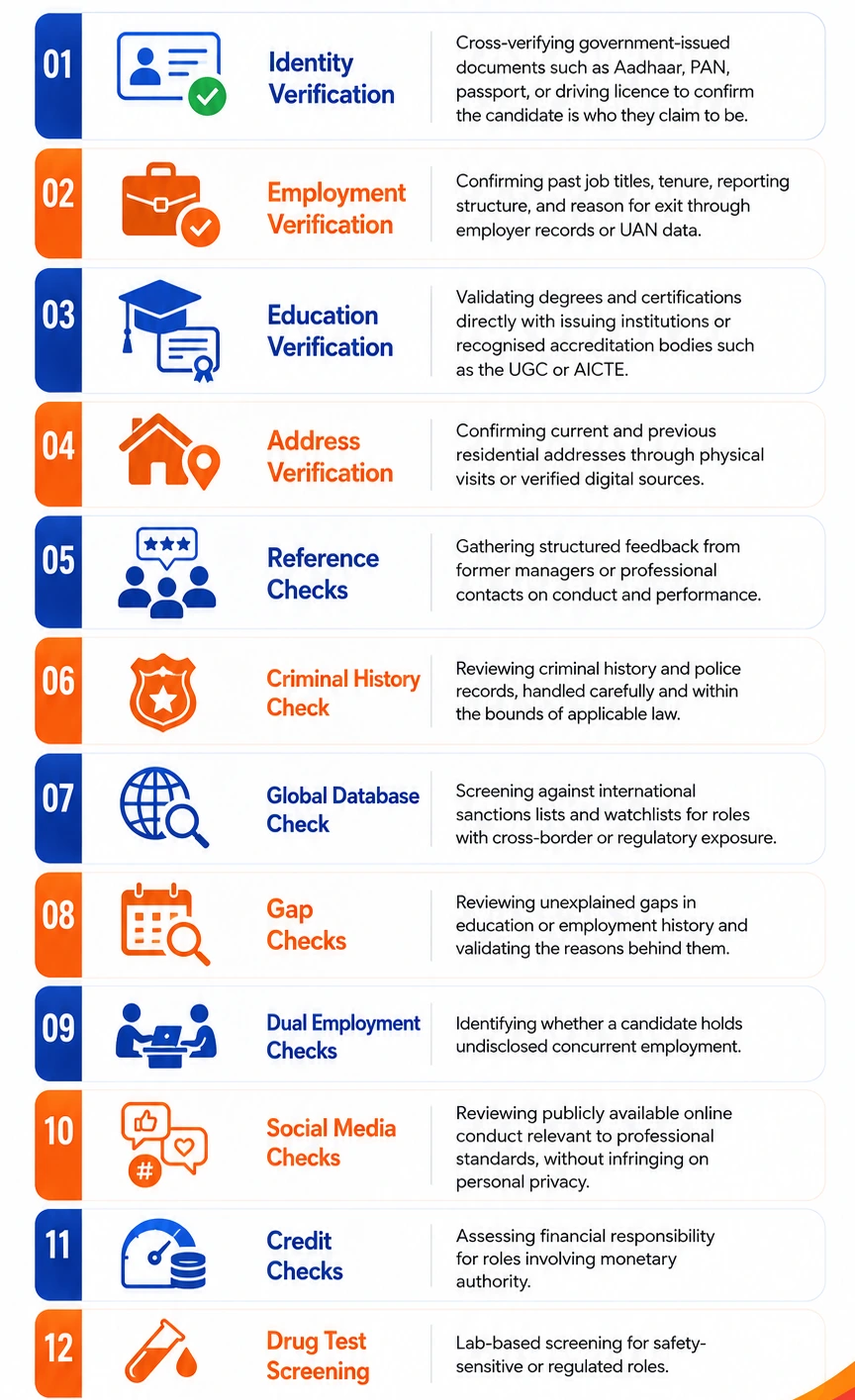
A comprehensive BGV programme typically draws on some or all of the following checks, scoped to the role in question:
- Identity Verification: Cross-verifying government-issued documents such as Aadhaar, PAN, passport, or driving licence to confirm the candidate is who they claim to be.
- Employment Verification: Confirming past job titles, tenure, reporting structure, and reason for exit through employer records or UAN data.
- Education Verification: Validating degrees and certifications directly with issuing institutions or recognised accreditation bodies such as the UGC or AICTE.
- Address Verification: Confirming current and previous residential addresses through physical visits or verified digital sources.
- Reference Checks: Gathering structured feedback from former managers or professional contacts on conduct and performance.
- Criminal History Check: Reviewing criminal history and police records, handled carefully and within the bounds of applicable law.
- Global Database Check: Screening against international sanctions lists and watchlists for roles with cross-border or regulatory exposure.
- Gap Checks: Reviewing unexplained gaps in education or employment history and validating the reasons behind them.
- Dual Employment Checks: Identifying whether a candidate holds undisclosed concurrent employment.
- Social Media Checks: Reviewing publicly available online conduct relevant to professional standards, without infringing on personal privacy.
- Credit Checks: Assessing financial responsibility for roles involving monetary authority.
- Drug Test Screening: Lab-based screening for safety-sensitive or regulated roles.
Common Mistakes to avoid during Background Screenings
- Inconsistent application across levels. Limiting checks to a few positions creates blind spots. A structured background screenings programme applies proportionate checks from entry-level to leadership roles, promoting fairness and reducing risk uniformly.
- Treating candidate privacy as an afterthought. Consent must be informed, documented, and revisited if the scope of checks changes. Work only with a verification partner that handles candidate data with the confidentiality required under the DPDP Act.
- Choosing a partner on price alone. Turnaround time, accuracy, and compliance discipline matter more than the lowest quote. A verification error costs far more than a delayed report.
Choosing the Right Background Screenings or Verification Partner
When evaluating a background screenings and verification partner, HR and compliance teams should look for:
- Demonstrated experience across the specific industries and role types being hired for
- A full range of verification checks available under one roof, rather than multiple vendors
- Clear data security and DPDP aligned privacy practices
- Realistic, well-communicated turnaround times
- Transparent reporting that flags discrepancies with context, not just a pass/fail stamp
- The ability to scale from a handful of hires to enterprise-level volumes
- Responsive account management and clear escalation paths
How Integritas Approaches Background Screenings and Background verification
At Integritas, we treat background screenings and verification as two connected but distinct disciplines. Every engagement starts with a screening scope built around the role and industry, whether that’s a standard identity-and-address check for a field role or a full corporate BGV programme covering employment, education, criminal history, and global database screening for a leadership hire.
From there, our verification teams do the actual work: cross-checking employment and education records directly with institutions and official sources, using AI-supported document review to flag inconsistencies early, and following DPDP-aligned, consent-driven processes throughout. Since our founding in 2017, we have supported over 500 organisations across IT/ITES, BFSI, healthcare, manufacturing, logistics, and recruitment, delivering reports with a typical turnaround of five working days and coverage across more than 60,000 pin codes in India.
The result for our clients is straightforward: a hiring process backed by verified facts rather than assumptions, and a screening programme that can stand up to internal audits and regulatory scrutiny alike.
FAQ’s
Are background verification and background screenings legally the same thing under Indian law?
No single Indian statute defines either term precisely. In practice, “screening” refers to the organisation’s overall due-diligence policy, while “verification” refers to the individual checks carried out under that policy. What matters legally is that whichever checks are run — screening or verification — are conducted with informed consent and in line with the DPDP Act.
Does every role need the same level of background verification?
No, Screening scope should be proportionate to role risk. A finance or leadership role typically warrants deeper verification involving employment, education, criminal, and global database checks while a gig or entry-level role may only need identity and address verification.
What happens if a discrepancy is found after a candidate has already joined?
Most organisations build this into their offer terms: if verification reveals a material discrepancy or false information post-joining, the offer can be rescinded or employment terminated, subject to the company’s own policy and applicable labour law.
Can background verification confirm experience at very small or unregistered companies?
It can, though the method changes. When formal HR records aren’t available, verification relies on alternate sources such as direct confirmation from a former manager, official communication trails, or supporting documentation, rather than a standard HR database lookup.
How does the DPDP Act affect background verification in practice?
It requires that candidate consent be clear, specific, and documented; that data collected is limited to what is necessary for the stated purpose; and that data is stored and disposed of securely. A verification partner should be able to demonstrate this at every stage of the process, not just claim it.
Is AI reliable enough to replace manual verification?
Not entirely, and it isn’t meant to. AI tools are effective at flagging inconsistencies, forged documents, and unusual patterns quickly, but they work best alongside trained researchers who can interpret context , for example, distinguishing a genuine job-title variation from an intentional misrepresentation.
Does Integritas actually follow DPDP Act practices in its verification process?
Yes, Integritas currently follows DPDP-aligned practices, including consent-driven data collection, limiting data use to the stated purpose, and secure storage and disposal of candidate information.