
Every hiring decision carries a certain amount of risk, but not all of that risk is visible on a resume. Behind polished cover letters and confident interviews, some candidates present information that simply isn’t true, fabricated job titles, forged degrees, hidden criminal records, or even fake identities. This is where fraud detection becomes a critical part of how organisations protect themselves during hiring and throughout the employee lifecycle.
Employee fraud isn’t limited to financial crimes committed after someone joins a company. It often begins much earlier, at the hiring stage, when a candidate misrepresents their background to secure a role they wouldn’t otherwise qualify for. Left unchecked, this can lead to internal theft, data breaches, reputational damage, and costly legal complications down the line.
This guide walks through what employee fraud looks like, why proactive fraud detection matters, and the screening methods organisations can use to catch problems before they become expensive mistakes.
What Is Employee Fraud?
Employee fraud refers to any dishonest or deceptive act carried out by a candidate or employee for personal gain, at the cost of the organisation. This can start during the hiring process itself through resume misrepresentation, fake credentials, or concealed criminal history and can continue after joining, through financial misconduct, data theft, or abuse of position.
Because so much of hiring today happens remotely, with digital resumes and virtual interviews, opportunities for deception have increased. For roles involving financial responsibility, organisations may conduct appropriate credit or financial checks, where legally permissible and relevant to the role. These checks can provide additional context when assessing financial-risk exposure, but should be considered alongside other verification results rather than treated as evidence of fraud.
Common Types of Employee Fraud
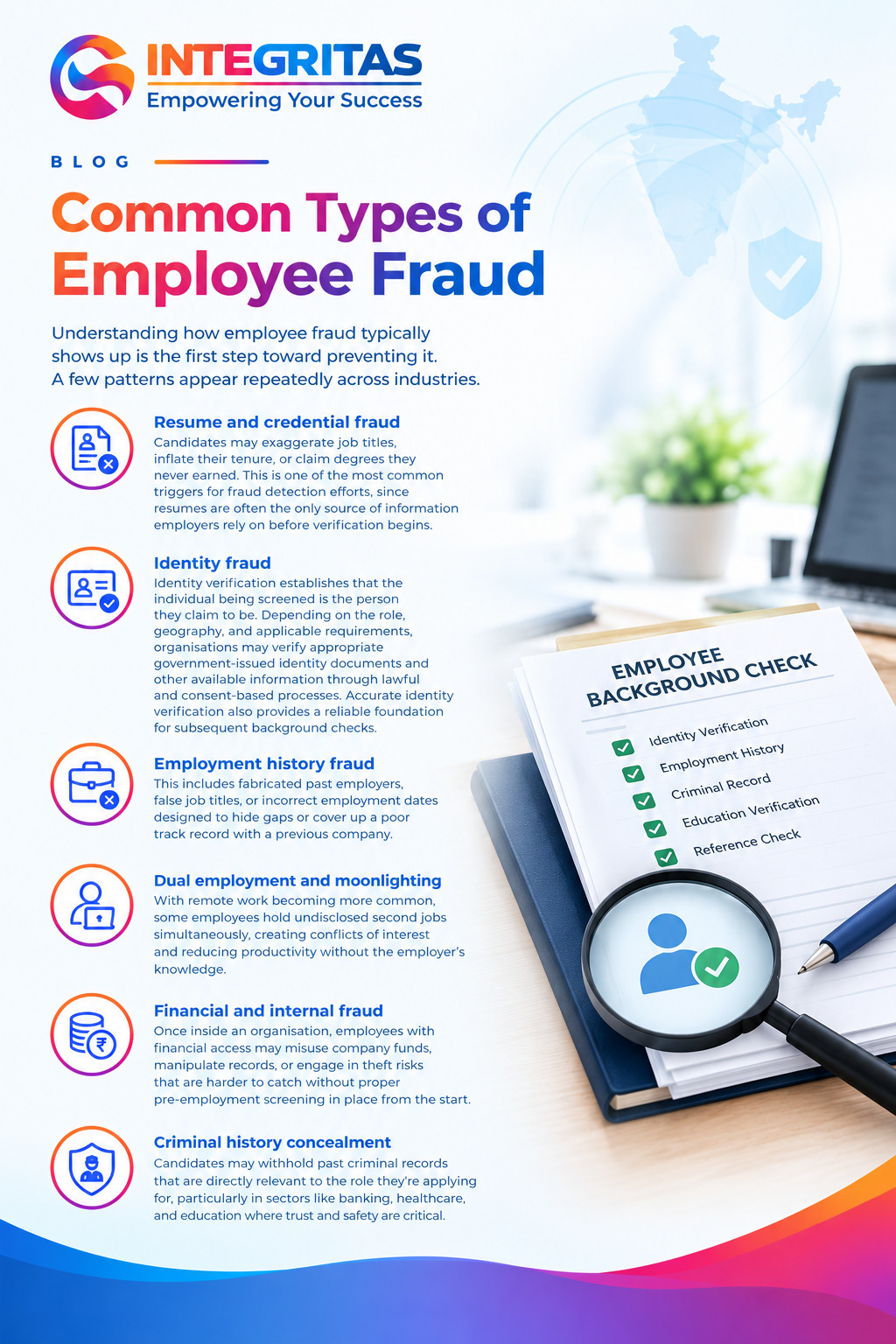
Understanding how employee fraud typically shows up is the first step toward preventing it. A few patterns appear repeatedly across industries.
Resume and credential fraud: Candidates may exaggerate job titles, inflate their tenure, or claim degrees they never earned. This is one of the most common triggers for fraud detection efforts, since resumes are often the only source of information employers rely on before verification begins.
Identity fraud: Identity verification establishes that the individual being screened is the person they claim to be. Depending on the role, geography, and applicable requirements, organisations may verify appropriate government-issued identity documents and other available information through lawful and consent-based processes. Accurate identity verification also provides a reliable foundation for subsequent background checks.
Employment history fraud: This includes fabricated past employers, false job titles, or incorrect employment dates designed to hide gaps or cover up a poor track record with a previous company.
Dual employment and moonlighting: With remote work becoming more common, some employees hold undisclosed second jobs simultaneously, creating conflicts of interest and reducing productivity without the employer’s knowledge.
Financial and internal fraud: Once inside an organisation, employees with financial access may misuse company funds, manipulate records, or engage in theft risks that are harder to catch without proper pre-employment screening in place from the start.
Criminal history concealment: Candidates may withhold past criminal records that are directly relevant to the role they’re applying for, particularly in sectors like banking, healthcare, and education where trust and safety are critical.
Each of these patterns is easier to prevent than to correct after the fact. A consistent, consent-based screening process helps organisations spot warning signs early and hire with greater confidence.
Hiring Fraud vs. Employee Fraud
Hiring fraud occurs when an individual provides false, misleading, or concealed information to obtain employment. Employee fraud, more broadly, can also occur after joining an organisation, such as misuse of company assets, financial misconduct, data theft, or abuse of authority.
Background verification primarily helps organisations identify risks associated with a candidate’s reported background before or during onboarding. It is an important risk-control measure, but it cannot eliminate every form of misconduct that may occur after hiring.
Why Fraud Detection Matters for Every Organisation
Fraud detection isn’t just a precaution for large enterprises it matters for organisations of every size and industry. A single case of employee fraud can lead to direct financial losses, damaged client relationships, legal exposure, and a longer-term hit to company reputation that’s far harder to repair than the original loss itself.
Beyond financial risk, hiring fraud also affects workplace culture. When a company hires someone based on false information, it can create unfair advantages over honest candidates, lower team morale once discrepancies surface, and increase turnover as unqualified hires struggle to meet expectations. Strong fraud detection practices help organisations avoid all of this by catching red flags before an offer is even extended.
Key Screening Methods for Fraud Detection
A full-service Background Verification Company in Ahmedabad offers many types of checks. The right mix depends on the role and the industry. Below are the most common ones.
Identity Checks
Identity checks are the foundation of any fraud prevention programme. This involves cross-verifying documents to confirm that a candidate is genuinely who they claim to be. Without accurate identity checks, every other verification step becomes far less reliable, since all subsequent checks are built on the assumption that the person being verified is real.
Employment Verification
Employment verification confirms a candidate’s past job titles, tenure, and reason for leaving by contacting former employers directly or cross-checking records such as UAN (Universal Account Number) data. This is one of the screening methods for catching fabricated experience, since it relies on independent, third-party confirmation rather than self-reported details.
Education Verification
Education verification authenticates academic records directly with the issuing institution, helping employers catch fake degrees or exaggerated qualifications. Education verification is particularly important for roles where specific academic credentials are a legal or regulatory requirement. It gives employers confidence that every hire is qualified on paper.
Address Verification
Address verification confirms a candidate’s current and previous residential details, adding another layer of confidence to overall identity validation and helping flag inconsistencies that may point to broader misrepresentation.
Criminal Record Check
Screening through police records, court data, and other databases helps detect undisclosed criminal history that could be directly relevant to a role. This is a critical part of fraud detection for sectors handling sensitive data or vulnerable individuals.
Credit and Financial Checks
For roles involving financial responsibility, evaluating a candidate’s creditworthiness through CIBIL score reports and related financial history helps assess risk before granting access to company funds or financial systems.
Global Database Screening
Scanning compliance databases helps organisations identify candidates with a history of fraud or regulatory violations, particularly relevant for companies with international operations.
Dual Employment Checks
Verifying whether a candidate is currently employed elsewhere helps prevent conflicts of interest and ensures compliance with any restrictions on holding multiple jobs simultaneously.
Resume Verification
Cross-checking the specific details listed on a candidate’s resume job titles, dates, certifications against verified records helps catch inflated claims before they translate into a hiring risk.
Reference Verification
Reference checks can provide additional context about a candidate’s previous employment, professional conduct, responsibilities, and working relationship with former colleagues or supervisors. When conducted appropriately, reference verification can complement employment and credential checks and help identify inconsistencies in a candidate’s reported background.
Step-by-Step Fraud Detection Process for Employers
A structured approach to fraud detection generally follows a few consistent stages:
- Data Collection: Candidate details are collected and entered into a secure verification system.
- Document Review: Submitted documents are reviewed for accuracy and completeness before verification begins.
- Trained research :Trained researchers authenticate the given information using multiple independent sources, including institutions, past employers, and official databases.
- Quality Review: A second team cross-checks the research findings to confirm accuracy and catch anything the initial review may have missed.
- Final Reporting :A clear verification report is prepared, outlining what was verified, what matched, and any discrepancies found.
- Decision Support : HR teams use the final report to make an informed hiring decision, backed by verified facts rather than assumptions.
Following this structured process consistently is what separates genuine fraud detection from a quick, surface-level check that misses important red flags. It helps employers make hiring decisions based on verified facts rather than assumptions.
Best Practices for Preventing Employee Fraud
Beyond running the right checks, a few practices help organisations strengthen their overall approach to fraud detection:
- Apply checks consistently: Limiting verification to only certain roles or seniority levels creates blind spots. A consistent approach across all hiring levels reduces overall exposure to employee fraud.
- Combine multiple screening methods: No single check catches everything. Using identity checks, employment verification, education checks, and criminal record checks together gives a far more complete picture than relying on just one.
- Review discrepancies with context: Not every mismatch is intentional fraud; a simple clerical error can look similar to a red flag. Reports should explain discrepancies clearly rather than issuing a blunt pass or fail.
- Re-verify for high-risk role changes: When an employee moves into a role with greater financial or data access, it’s worth revisiting screening to confirm nothing has changed since their original hire.
- Work with an experienced verification partner: A provider with a proven, structured process is far more likely to catch subtle inconsistencies than an internal team handling checks on an ad hoc basis.
- Use a risk-based approach: Not every role carries the same level of risk. Organisations can determine appropriate verification requirements based on factors such as financial access, sensitive information, regulatory requirements, seniority and the nature of the role.
Common Red Flags That May Require Further Verification
Some inconsistencies do not automatically indicate fraud, but they may require additional review. Examples can include:
- Differences between resume information and employer-confirmed employment dates
- Job titles or responsibilities that cannot be independently confirmed
- Education details that differ from institutional records
- Unexplained gaps or inconsistencies in employment history
- Identity information that does not match across submitted records
- Multiple conflicting addresses or personal details
- Information that changes between the application, interview, and verification stages
- Unexplained discrepancies in documents or supporting information
How Integritas Supports Fraud Detection for Employers
At Integritas, background verification is built into every stage of how we help organisations reduce hiring risk. Our services span identity, employment, education, address, criminal and court record, credit, global database, reference, resume, and dual employment checks which gives organisations a complete picture of a candidate before they join, rather than relying on any single check in isolation.
Every engagement follows a structured process: data collection, verification, independent source validation, quality review, discrepancy identification, and final reporting. Candidate details are entered into our verification portal, account managers confirm the submitted information, trained researchers authenticate documents through multiple independent sources, a quality review team checks the findings, and a final report is prepared with clear notes on any discrepancies found.
Whether you’re screening for a single specialised hire or running background checks across a large workforce, our team scopes the verification process to match the risk profile of the role helping you build a hiring process based on verified facts rather than assumptions.
Looking to strengthen your employee fraud prevention process? Speak with Integritas about building a structured background verification program aligned with your organisation’s hiring requirements and risk profile.
FAQ’s
What is fraud detection in the context of hiring?
Fraud detection refers to the process of identifying false or misleading information a candidate provides during hiring including fake credentials, misrepresented employment history, or concealed criminal records before a hiring decision is made.
What are the most common types of employee fraud?
The most common types include resume and credential fraud, identity fraud, fabricated employment history, undisclosed dual employment, and concealment of relevant criminal history.
Which screening methods can help catch fraud?
A combination of identity checks, employment verification, education verification, address verification, and criminal history checks together provides the most reliable results, since each check confirms a different part of a candidate’s background.
Why are identity checks considered the foundation of fraud detection?
Identity checks confirm that a candidate is genuinely who they claim to be. Without this confirmation, all subsequent verification steps become less reliable, since they rely on the assumption that the person being checked is real.
How does employment verification help prevent hiring fraud?
Employment verification confirms a candidate’s past job titles, tenure, and reason for leaving through independent sources like former employers or UAN records, making it much harder for fabricated experience to go unnoticed.
Can employee fraud happen even after a thorough hiring process?
Yes, while strong pre-employment screening significantly reduces risk, ongoing awareness and periodic re-verification for high-risk roles help organisations stay protected as responsibilities change over time.
How does Integritas help with employee fraud detection?
Integritas offers a full range of screening checks under a structured, multi-stage verification process, helping organisations confirm candidate information accurately before extending an offer.