
Hiring the right employee involves more than reviewing a resume and conducting interviews. Employee Background Verification (BGV) helps organisations validate a candidate’s identity, employment history, educational qualifications and other role-relevant information before making informed hiring decisions. In India, the checks required can vary by role, industry, employer policy, available records and applicable legal requirements. This guide provides a practical BGV checklist, explains common checks and discrepancies, and helps HR teams approach verification consistently and responsibly.
What Are BGV Checks and Why Do HR Teams in India Need Them?
Employee background verification involves checking a candidate’s identity, employment, education, address and other role-relevant information before or after joining, depending on the employer’s policy and the circumstances. Employers use BGV to validate relevant claims and manage hiring risks. The scope should be proportionate to the role and consistent with applicable law.
BGV stands for background verification. Some people use “background checks” and “background verification” interchangeably, and in everyday HR conversations they mean the same thing: confirming that what a candidate claims is true, using independent and authorised sources.
India’s workforce spans many industries, employers and locations. Verification can help HR teams validate relevant information beyond resumes and interviews. The process should use appropriate independent sources, document limitations and avoid treating an unverified claim as automatically false.
Reliable background verification protects more than the hiring decision. It protects customer data, company assets, workplace safety, and the employer brand. In regulated sectors such as banking, insurance, healthcare, and education, it also supports compliance and audit readiness.
What Does a Complete Employee BGV Checklist Include?
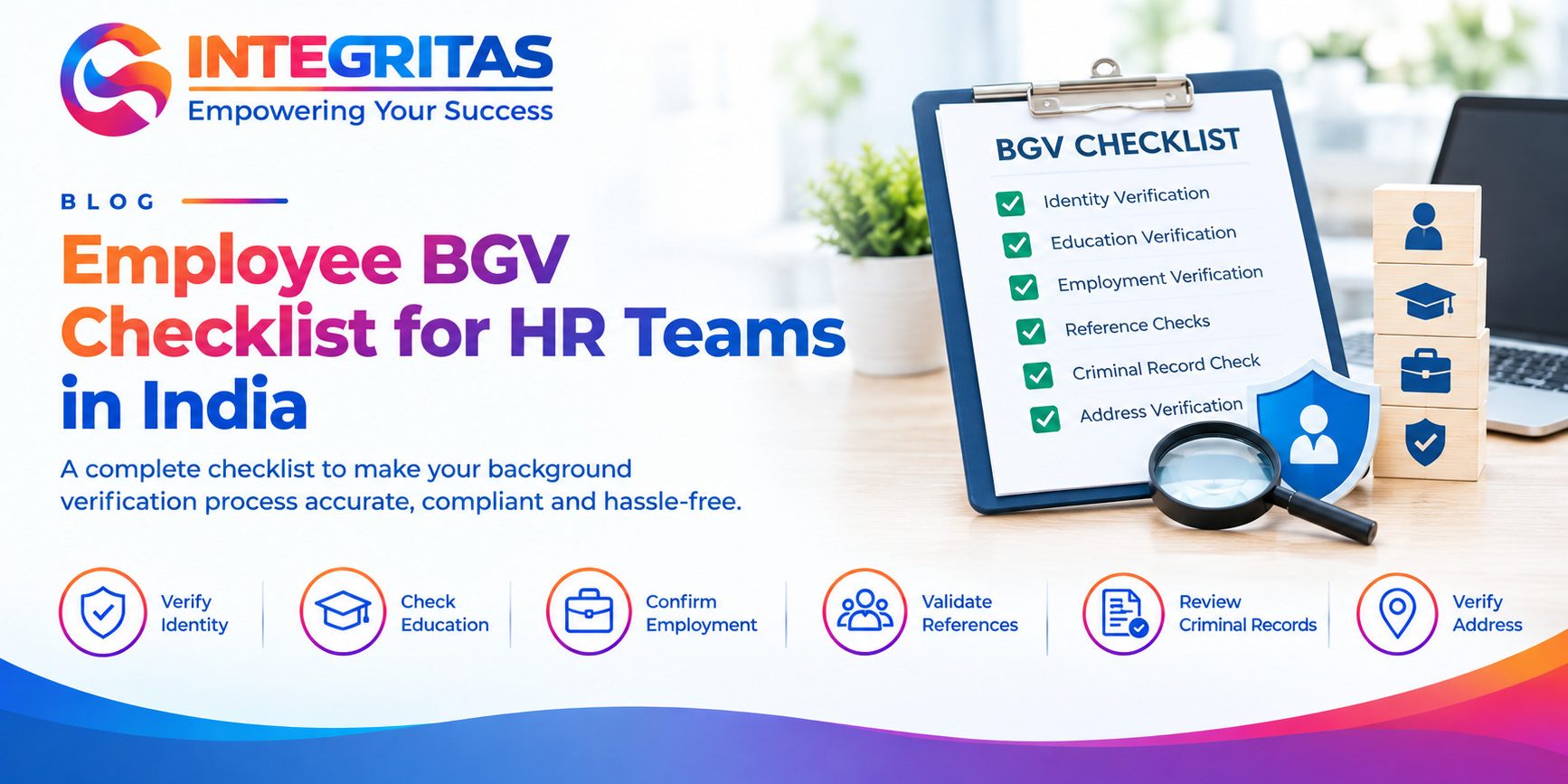
An employee BGV checklist may include identity, employment, education, address, criminal-record and reference checks. Additional checks—such as sanctions screening, credit checks, UAN/EPFO-related checks, employment-gap review or public online information review—should be considered only where relevant to the role, proportionate to the purpose, and legally appropriate.
Here is the checklist at a glance:
- Identity verification: appropriate government-issued or other permitted identity evidence, using lawful and proportionate methods
- Employment verification: employer, designation and employment dates; other details where relevant and available
- Education verification: degrees and certificates confirmed with the issuing body
- Address verification: current and permanent address
- Criminal record check: defined searches of available court or other authorised records, with clear scope and limitations
- Reference checks: feedback from previous managers
- Global database check: sanctions and watchlists
- Credit check: for finance-sensitive roles
- UAN/EPFO-related checks: employment information or overlaps where relevant, available and lawfully accessible
- Gap verification: unexplained breaks in education or work
- Public online information review: only where there is a legitimate role-related purpose and appropriate safeguards
Not every candidate needs every item. The best HR teams define BGV checks by role risk, not by habit. A fresher joining a support team does not carry the same risk as a finance manager who approves payments or an IT engineer with access to customer data. Treating both the same either wastes budget on over-screening or leaves critical roles exposed. A simple way to decide is to ask three questions for every role: Does this person handle money, data, or customers? Do they work independently or in a position of trust? The more “yes” answers, the deeper your background verification should go.
How Do You Verify a Candidate’s Identity?
Identity verification helps establish whether the candidate’s identity details are consistent with the evidence provided. The documents and methods used should be appropriate to the check and comply with applicable requirements.
Identity discrepancies can affect the reliability of other checks. Review mismatches carefully, confirm that records relate to the correct person, and give the candidate a reasonable opportunity to clarify material differences.
Request only the identity information and documents necessary for the stated purpose. There is no universal requirement to collect two identity documents from every candidate. Use Aadhaar only in ways permitted by applicable UIDAI requirements, offer appropriate alternatives where applicable, and protect any personal data collected. Explain the purpose and follow the applicable legal basis and notice/consent requirements.
How Do You Verify Employment History?
Employment verification may confirm a candidate’s employer, designation and joining or exit dates through the former employer or other suitable records. Additional details—such as responsibilities, reason for leaving or compensation—may not always be available and should be requested only where relevant and appropriate.
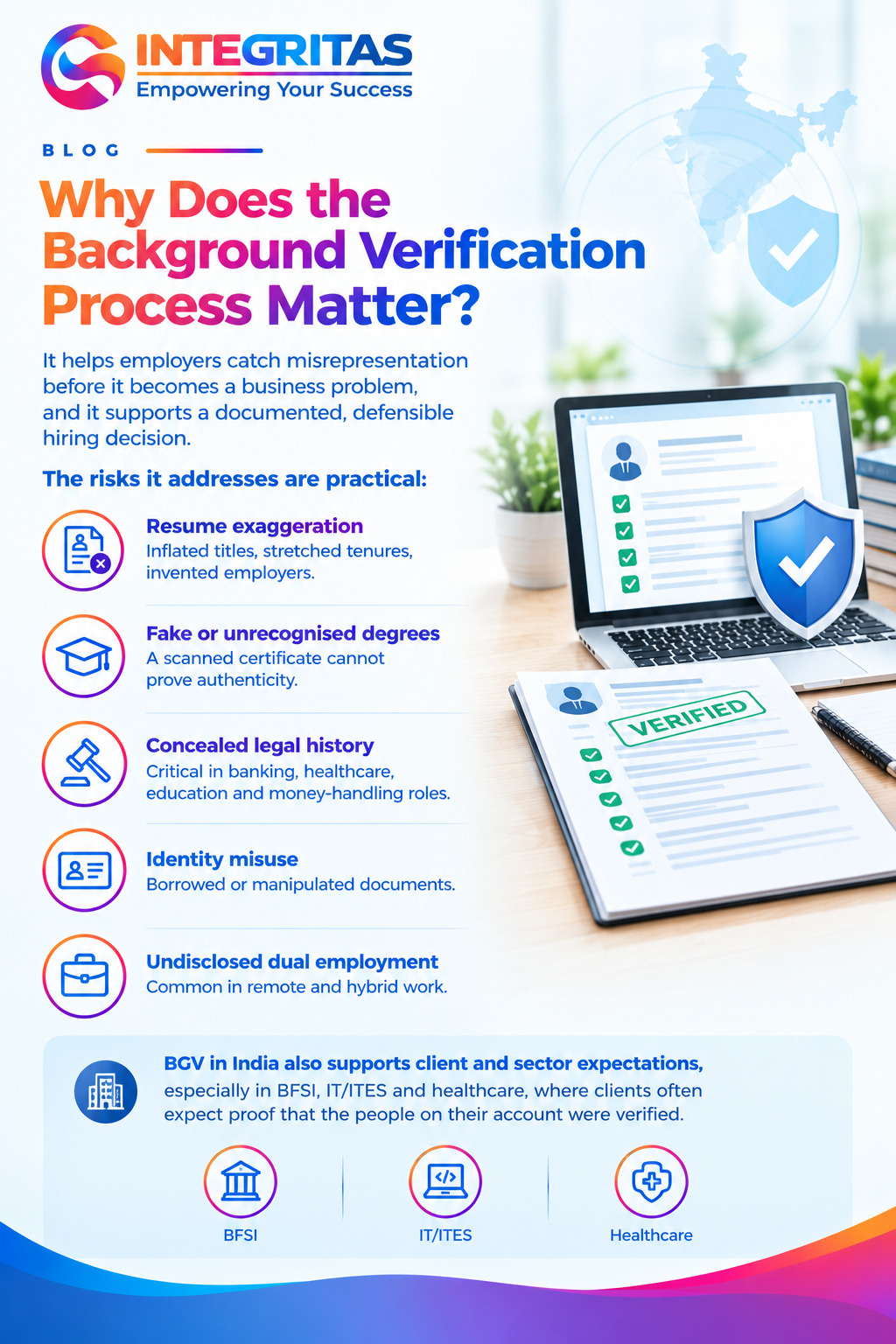
This is among the most important bgv checks because experience claims drive salary, designation, and trust. Common red flags include inflated tenure, upgraded job titles, fabricated companies, and fake relieving letters.
A strong process includes:
- Contact an independently identified or appropriately validated employer contact where feasible; document the source used and any limitations.
- Use EPFO/UAN-related information only where available, relevant and lawfully accessible; do not treat it as a complete record of every form of employment.
- Confirm designation and employment dates, and request other details only where relevant, available and appropriately authorised.
- Documenting alternate sources when a former employer is unresponsive, closed, or too small to have formal HR
A discrepancy in employment dates or job details should be checked against the available evidence and the candidate’s explanation. Avoid assuming that a short tenure or an unavailable record proves deliberate misrepresentation.
How Do You Verify Education Credentials?
Education verification confirms degrees, diplomas, and certificates directly with the issuing university, board, or institution, and checks that the institution is recognised.
Fake degrees and unrecognised institutions remain a real problem in India. Education verification protects you from hiring underqualified candidates for technical, regulated, or senior positions.
Verify the following:
- Name of the institution and the university or board it is affiliated with
- Course name, year of passing, and roll number
- Mode of study (regular, distance, or part-time)
- Recognition of the institution by relevant regulators such as UGC or AICTE, where applicable
For roles requiring professional licences, such as chartered accountants, doctors, or engineers, also verify membership or registration with the relevant professional body.
Why Is Address Verification Part of BGV Checks?
Address verification may use a physical visit, digital method or other appropriate evidence, depending on the service, location and employer requirements. Explain what the method confirms and its limitations; an address result alone does not establish a person’s character or suitability.
Address checks may be relevant for roles involving field work, customer premises, logistics or company assets. A mismatch should be investigated and interpreted in context; it does not by itself prove identity fraud or an unstable background.
The method and coverage vary by provider and location. State whether the check was physical or digital, what evidence was reviewed, and any limitations. Do not imply that one method is universally more accurate or suitable.
Are Criminal Record Checks Necessary for Every Hire?
Criminal-record screening may involve searches of specified court records or other authorised sources, depending on the scope, jurisdiction and service used. No single search should be described as a definitive check of every possible criminal record across India.
The relevance and scope of criminal-record checks depend on the role, sector, applicable requirements and employer policy. Avoid describing such checks as universally mandatory unless a specific legal or contractual requirement applies.
A search result is not, by itself, proof of guilt or an automatic reason to reject a candidate. Confirm identity matching and record status, consider the relevance of the information to the role, document the assessment, and give the candidate a fair opportunity to explain material findings.
What should HR do when a discrepancy is found?
Confirm that the information belongs to the correct candidate, review the source and scope, check whether the difference is material to the role, and request clarification where appropriate. Record the evidence and rationale for the final decision. Apply the same documented approach to comparable cases.
How Useful Are Reference Checks?
Reference checks gather role-relevant feedback from appropriately identified former managers or other referees. They can add context but should be interpreted alongside other evidence and should not be treated as a substitute for factual verification.
Documents confirm facts, but references reveal behaviour: teamwork, attendance, integrity, and reason for leaving. For senior and leadership hires, reference checks are among the most valuable bgv checks.
Make them effective by:
- Speaking to supervisors, not just peers
- Asking consistent, role-relevant questions
- Cross-verifying references against employment records
- Treating unusually vague or overly positive feedback with caution
Which Additional BGV Checks Should HR Teams Consider?
Beyond the core checklist, HR teams should consider global databases, credit, dual employment, UAN, employment gap, and social media checks, depending on role risk and industry.
Global database check
Screens names against international sanctions lists and regulatory watchlists. It is useful for companies with global clients or compliance obligations.
Social media check
Reviews publicly available content for conduct that conflicts with the role. It should be limited to public information and handled with sensitivity.
Dual employment check
Detects whether a candidate is working full-time elsewhere. This has become more relevant with remote and hybrid work.
UAN verification
Uses provident fund records to validate employment dates and spot overlaps.
Gap verification
Examines breaks in education or employment so that timelines are complete and credible.
Credit check
Reviews financial discipline for roles that handle funds, such as accounting, banking, and senior finance.
How Does Consent Work in Background Checks Under Indian Law?
Candidate consent is essential before running any background verification. Under India’s Digital Personal Data Protection (DPDP) Act, 2023, employers should collect only necessary personal data, for a stated purpose, with clear consent.
Consent-first practice protects both the candidate and the employer. In practice, HR teams should:
- Take written or digital consent before initiating bgv checks
- Explain which checks will be run and why
- Collect only the data needed for the role
- Store candidate data securely and delete it when it is no longer needed
- Choose a verification partner that follows documented, DPDP-aligned practices
What Is the Step-by-Step Background Verification Process?
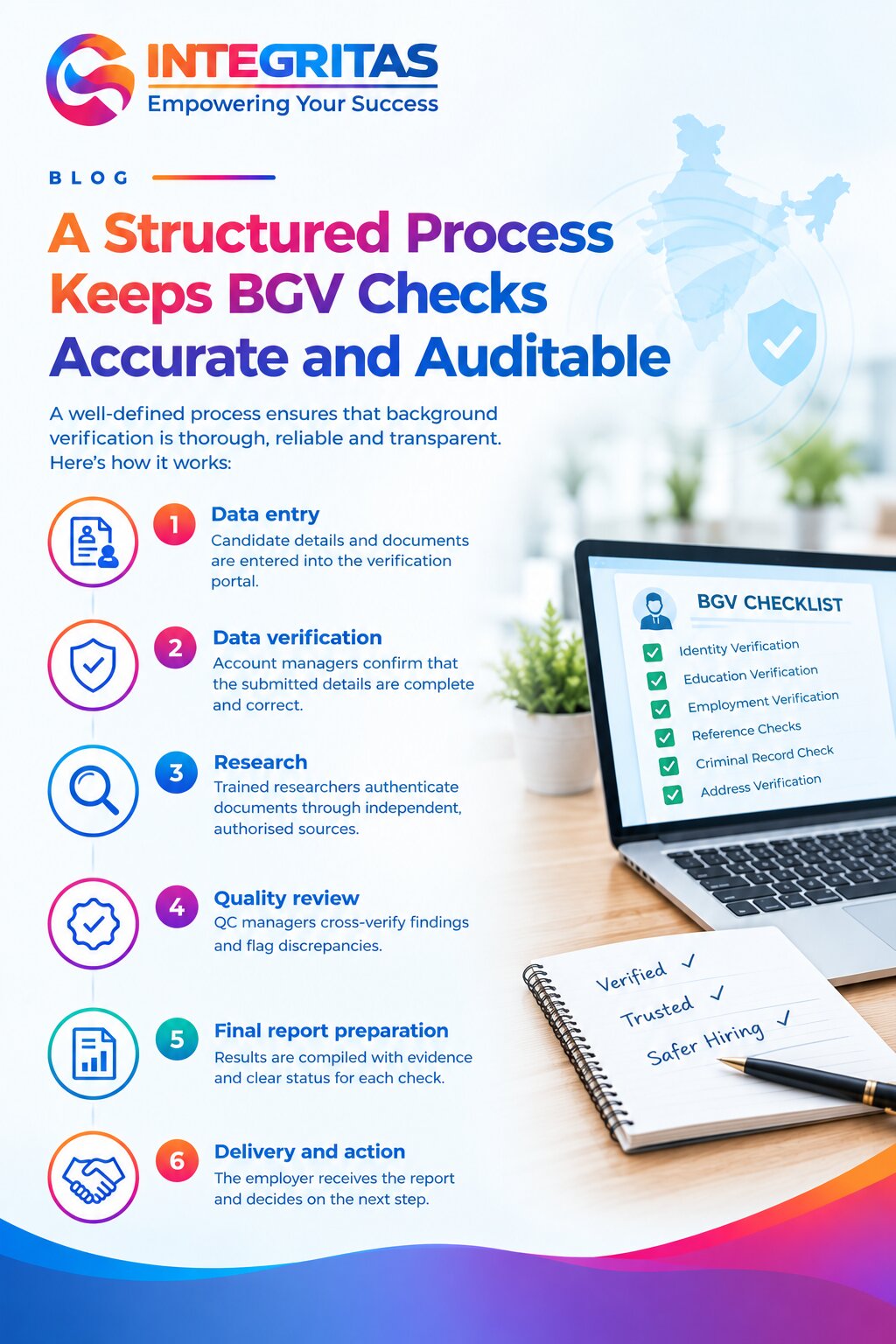
The background verification process typically runs through six stages: data entry, data verification, research, quality review, final report preparation, and delivery to the employer.
A structured process keeps bgv checks accurate and auditable:
- Data entry: Candidate details and documents are entered into the verification portal. Clean, complete input at this stage prevents delays later, so HR should share full names, dates of birth, previous employer details, and legible document copies upfront.
- Data verification: Account managers confirm that the submitted details are complete and correct. They catch spelling mismatches, missing documents, and incomplete employer contacts before research begins, which saves time and avoids rework.
- Research: Trained researchers authenticate documents through independent, authorised sources. This includes contacting universities, former employers, court databases, and official records rather than relying on candidate-supplied contacts.
- Quality review: QC managers cross-verify findings and flag discrepancies. A second pair of eyes ensures that errors, inconsistencies, and borderline cases are examined before anything reaches the client.
- Final report preparation: Results are compiled with evidence and a clear status for each check. A good report explains what was verified, how, and what any discrepancy means, so HR does not have to guess.
- Delivery and action: The employer receives the report and decides on the next step. This is where HR applies its screening policy, discusses any discrepancy with the candidate, and records the final decision.
Turnaround depends on how many checks are involved and how quickly institutions and former employers respond. Many providers complete standard packages within a few working days, though complex or field-based checks can take longer.
What Mistakes Should HR Teams Avoid?
The most common mistakes are verifying after the candidate has already joined, skipping consent, applying checks inconsistently, and treating every discrepancy as fraud.
Watch out for these:
- Starting late: Initiate bgv checks at offer stage, not weeks after onboarding.
- Inconsistent policy: Screening some hires deeply and others not at all creates legal and fairness risk.
- Ignoring small discrepancies: Minor date mismatches may be harmless, but patterns matter.
- Overreacting: A discrepancy needs context. Give candidates a chance to explain.
- Poor documentation: Keep consent forms, reports, and decisions on record.
- Choosing on price alone: The cheapest vendor can mean slow reports, weak sources, and compliance gaps.
How Do You Choose a Background Verification Company?
Choose a background verification company based on its industry experience, range of checks, technology, compliance discipline, and transparent reporting, not price alone.
Look for these qualities:
- Breadth of checks: One partner for identity, employment, education, criminal, address, and global checks keeps reporting consistent.
- Technology and accuracy: Digital workflows, automated tracking, and document-review tools catch forgeries faster.
- Compliance: Consent-driven processes aligned with the DPDP Act and clear data-handling policies.
- Turnaround and communication: Predictable timelines and responsive support.
- Report quality: Reports that explain discrepancies with context, not just a pass or fail.
- Customisation: Packages tailored to your roles and industry rather than a fixed template.
Providers such as Integritas offer end-to-end employee background verification with a structured six-stage process and role-based packages, which helps HR teams scale bgv checks without building the capability in-house.
How Does Integritas Help HR Teams Run BGV Checks in India?
Integritas is a background verification company in India that helps employers run accurate, consent-based BGV checks through a structured six-stage process. It has over seven years of experience in employee background verification and serves HR teams across major business hubs.
Integritas works as an extension of your HR team. Instead of chasing universities, former employers, and court records yourself, you share the candidate details and consent, and the Integritas team handles research, quality review, and reporting. That means faster, more consistent bgv checks without building a verification team in-house.
Which BGV checks does Integritas cover?
Integritas covers the full employee BGV checklist discussed in this guide:
- Identity verification
- Employment verification
- Education verification
- Address verification
- Criminal history check
- Reference checks
- Global database check
- Credit check
- Dual employment and moonlighting check
- UAN and employment gap verification
- Resume verification
Packages are customised to the role and industry. A BFSI hire, a BPO agent, and a logistics driver do not carry the same risk, so their background checks should not look the same.
Need reliable BGV checks for your next hire? Contact Integritas today for a customised background verification package.
FAQ’s
What are BGV checks in India?
BGV checks are verifications of a candidate’s identity, employment history, education, address, and criminal record before or soon after hiring. Employers use them to confirm that a candidate’s claims are accurate.
Are BGV checks mandatory for employees in India?
No single law requires BGV checks for all employers. However, many regulated sectors such as banking, healthcare, and security expect or require them, and many companies make them part of hiring policy.
How long do BGV checks take?
Timelines vary with the number and type of checks, plus how fast institutions respond. Basic packages often finish in a few working days, while field visits and international checks take longer.
What documents do candidates need for background verification?
Typically, identity proof (such as Aadhaar or PAN), education certificates, previous employment letters, relieving letters, recent payslips, and address proof.
What happens if a BGV report shows a discrepancy?
HR should review the details, give the candidate a chance to explain, and judge the discrepancy against the role. Minor errors differ from deliberate misrepresentation.
Can background verification be done after joining?
Yes, but it is better to start at the offer stage. Verification after joining leaves risk exposure during the review period and can complicate decisions if issues appear.
Do BGV checks cover freshers?
Yes. For freshers, the focus is on identity, education, address, and sometimes internships or references, since they have little employment history.
Is it legal to run social media checks on candidates?
Reviewing publicly available information with the candidate’s knowledge is generally acceptable, but employers should stay role-relevant and avoid intrusive or discriminatory use. Check with legal counsel for your situation.
What is the difference between background checks and background verification?
In everyday use they mean the same thing. Some professionals use “screening” for broader risk assessment and “verification” for confirming specific claims.
Should small companies and startups run BGV checks?
Yes. Smaller teams are often hit hardest by a bad hire, so even a lean package of identity, education, and employment checks is worth having.