
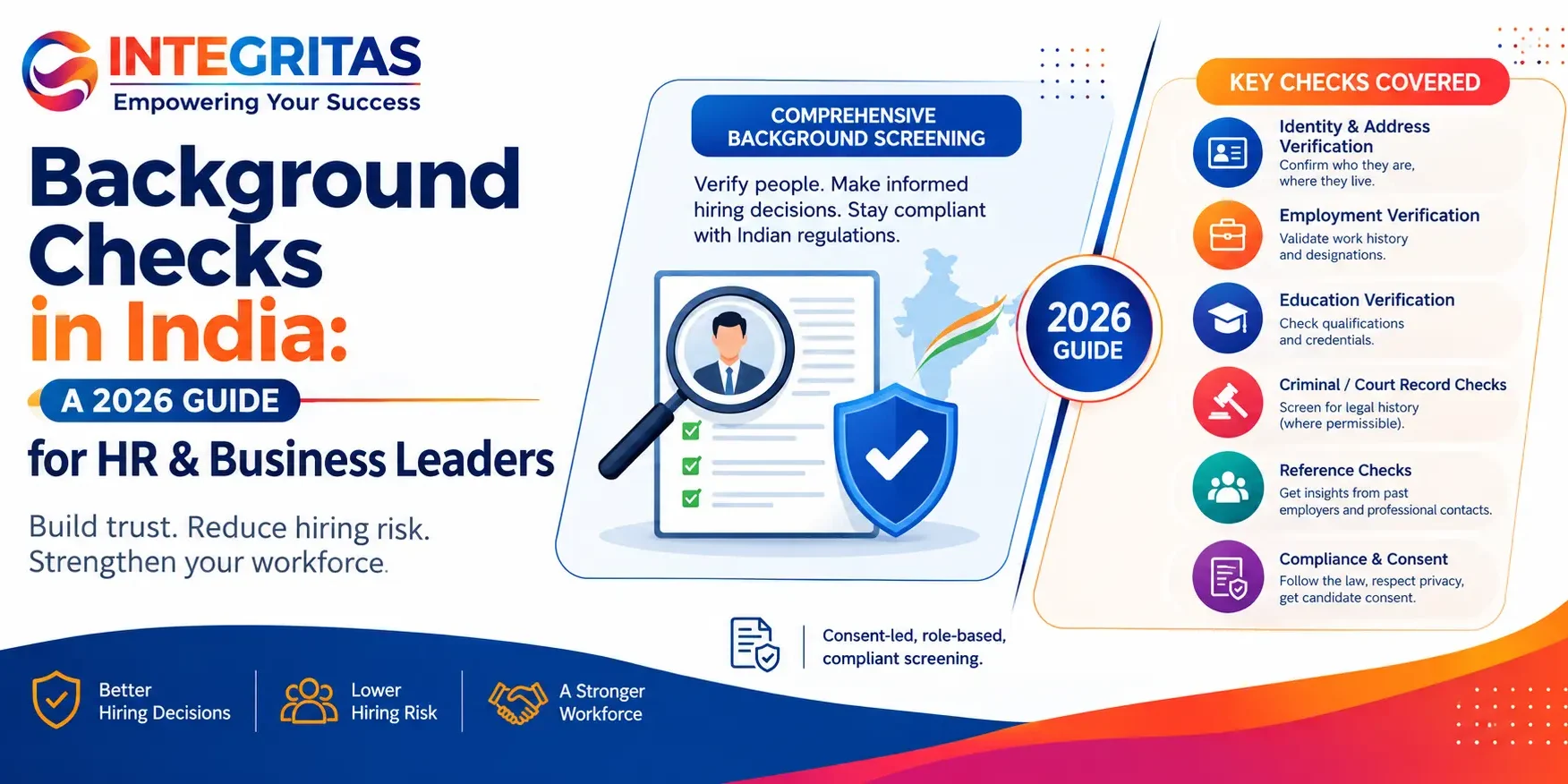
A polished resume, a confident interview, and strong references can still hide a critical gap between what a candidate claims and what is actually true. Industry estimates suggest that a significant share of resumes in India, by some counts, nearly one in five contains discrepancies ranging from inflated job titles to fabricated degrees. For HR teams and business leaders, that gap is no longer a minor hiring risk; it is a compliance, security, and brand-trust issue.
Background verification (BGV) exists to close that gap. Done well, it protects organisations from resume fraud, safeguards sensitive data and assets, and builds the foundation for confident, informed hiring decisions. This guide explains what background verification involves, how the process works in India today, what has changed under India’s new data protection law, and how Integritas helps organisations screen candidates accurately and compliantly.
What Is Background check?
Background check is the structured process of validating the information a candidate provides during recruitment like identity, education, employment history, address, references, and legally appropriate, criminal records. Rather than taking a resume at face value, employers use BGV to confirm that a candidate’s claims match verifiable facts.
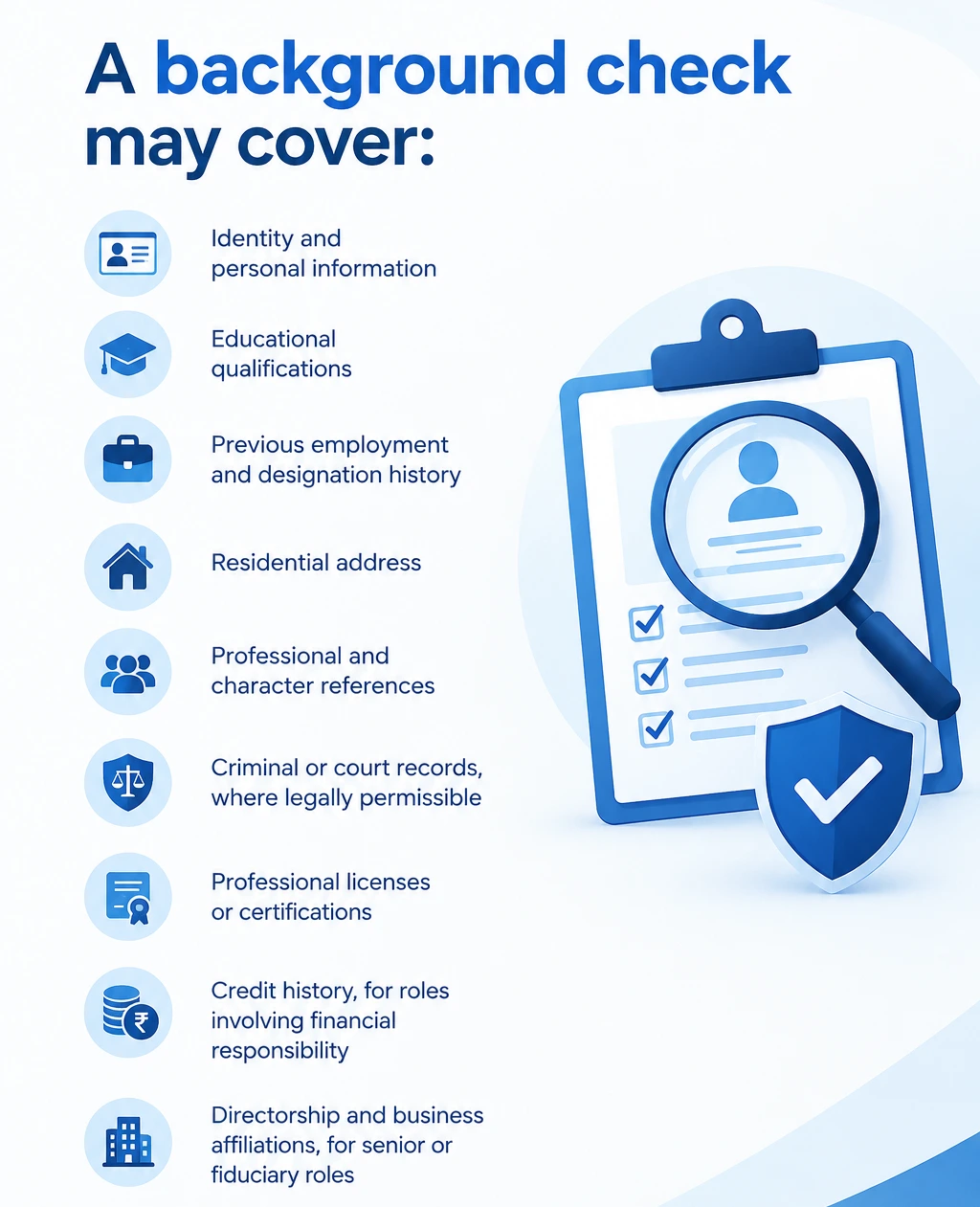
A background check may cover:
- Identity and personal information
- Educational qualifications
- Previous employment and designation history
- Residential address
- Professional and character references
- Criminal or court records, where legally permissible
- Professional licenses or certifications
- Credit history, for roles involving financial responsibility
- Directorship and business affiliations, for senior or fiduciary roles
Why Background Verification Matters in India
Background check has always mattered to hiring quality. What has changed is the scale of the risk and the regulatory weight behind getting it right.
Resume fraud is a persistent, measurable problem: Background Verification agencies consistently report that a meaningful proportion of checks surface some discrepancy in employment history, education, or identity, enough that skipping verification is no longer a reasonable trade-off for speed.
Hybrid and remote hiring have widened the risk surface: When a candidate is verified and onboarded without ever stepping into an office, employers lose many of the informal checks that used to catch inconsistencies early. Digital-first verification has become the primary safeguard.
New forms of hiring fraud are emerging: AI-generated documents, deepfake video interviews, and moonlighting, where an employee holds undisclosed parallel employment have added new categories of risk that traditional paper-based checks were never designed to catch.
Data protection law now applies directly to BGV: The Digital Personal Data Protection Act, 2023 (DPDP Act), with Rules notified in November 2025, makes every employer a “Data Fiduciary” for the personal data collected during background checks.
Together, these factors mean that a generic, one-size-fits-all approach to BGV is no longer sufficient. Organisations need verification partners who understand both the operational side of screening and the regulatory environment it now sits within.
How Background check Works
A reliable background check process generally follows four stages:
- Candidate consent. Verification cannot lawfully begin without the candidate’s explicit, informed consent. Under the DPDP Act, this means a clear, standalone consent record, not a buried clause in an offer letter that tells the candidate exactly which checks will be run and why.
- Information and document collection. The candidate provides the details and supporting documents needed for the selected verification package. Depending on scope, this may include full name, date of birth, contact details, past employer details, education records, address history, identification documents, and reference details.
- Verification. The verification partner validates each data point against authorised sources, employer records, educational institutions, government databases, and direct reference contact depending on the check type.
- Reporting and decision-making. A consolidated verification report is shared with the employer, flagging any confirmed information, discrepancies, or gaps. Where a mismatch is found, the employer typically reviews the finding and, where appropriate, gives the candidate an opportunity to clarify before any adverse hiring decision is made.
Types of Background Checks
- Identity Verification Confirms that the candidate is who they claim to be, typically by validating government-issued identification. This is usually the first check performed, since every other verification is anchored to a confirmed identity.
- Address Verification Validates residential details through a mix of digital verification, document checks, database checks, and, where required, physical field verification.
- Employment Verification One of the most requested and most revealing checks. It confirms company name, tenure, designation, department, and reason for leaving, directly with previous employers or through authorised employment records. Given how often self-reported employment history is exaggerated, this check is central to reducing hiring risk.
- Education Verification Confirms that a candidate genuinely studied at the institution, in the course, and during the period claimed. It is particularly important for roles requiring a specific degree, technical qualification, or professional license.
- Reference Verification gathers first-hand insight into a candidate’s work style, conduct, and performance by contacting the professional references provided.
- Criminal and Police Verification Checks court and police records through authorised channels, in line with applicable Indian laws and privacy safeguards, to flag risks relevant to workplace safety.
- Credit and Financial Checks Reviews credit history (such as CIBIL reports) for roles that carry financial responsibility or access to company funds.
- Global Database and Social Media Screening Cross-checks candidates against global watchlists and sanction databases, and reviews publicly available professional information which is useful for senior hires, cross-border roles, and organisations with global compliance obligations.
- Directorship, GSTIN, and Moonlighting Checks Increasingly relevant checks that confirm whether a candidate holds undisclosed directorships, business registrations, or parallel employment which ensures closing the gaps that traditional employment checks can miss.
Documents Required for an effective Background check
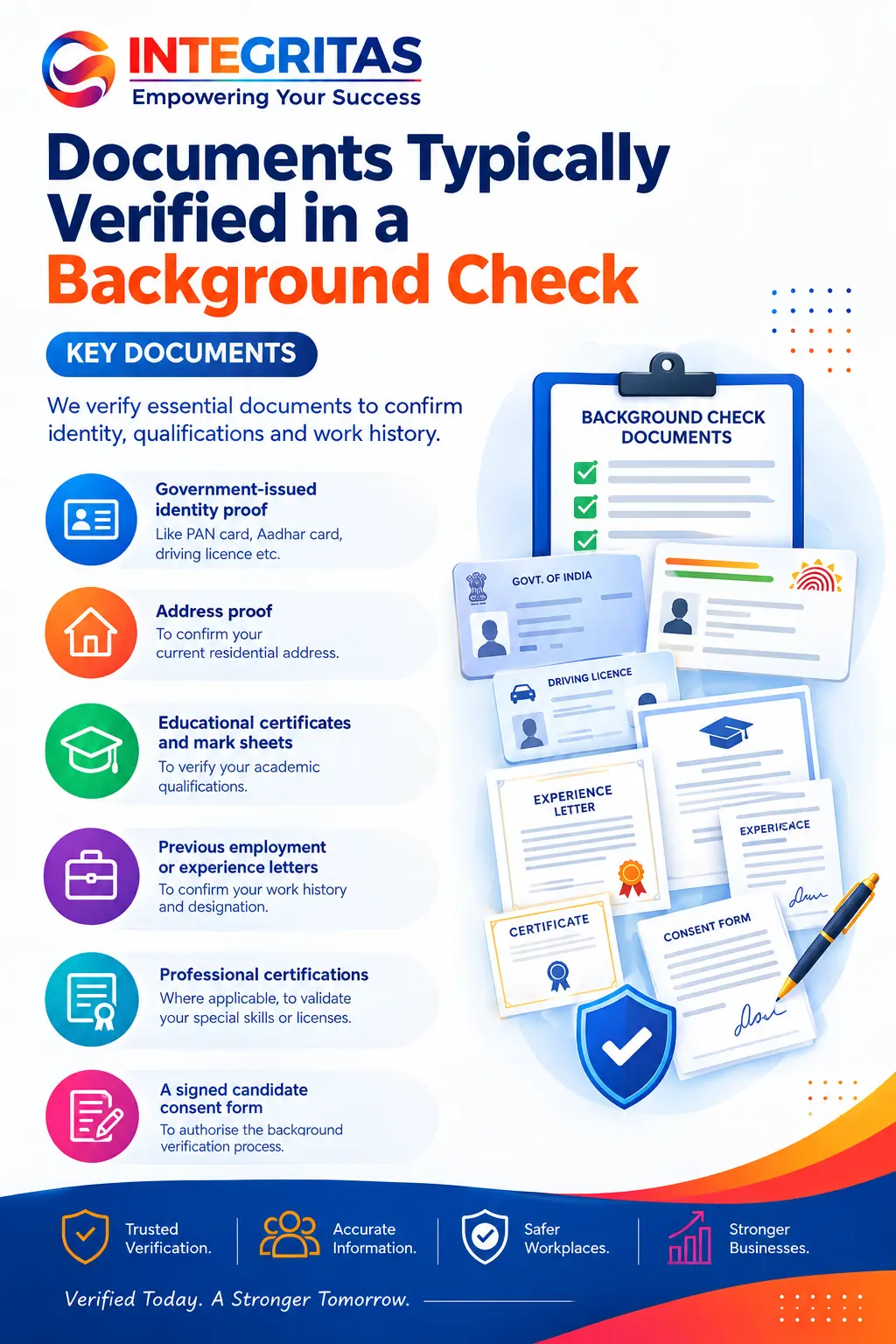
The exact document list depends on the verification package selected, but commonly includes:
- Government-issued identity proof like pancard, aadhar card, driving licence etc
- Address proof
- Educational certificates and mark sheets
- Previous employment or experience letters
- Professional certifications, where applicable
- A signed candidate consent form
Employers should collect only what is reasonably necessary for the specific checks being run, and store it securely so as to maintain the privacy of the employee.
Data Privacy and Compliance: What’s Changed
This is the section HR teams cannot afford to skip in 2026.
The DPDP Act, 2023, with its Rules notified in November 2025, directly governs how personal data is collected, used, and stored during background checks. Under the DPDP framework, organisations involved in processing personal data have responsibilities based on their role in the processing. In practice, this means:
- Consent must be explicit and specific: A generic checkbox is not sufficient; candidates must be clearly informed of what will be checked and why.
- Data minimisation applies: Employers and verification partners should collect only the data that is genuinely required for the role and the checks in question, not everything that could conceivably be useful.
- Outsourcing does not transfer liability: Organisations should clearly define data-protection responsibilities with their BGV providers through appropriate agreements and security measures.
- Retention limits apply. Personal data of candidates who are not hired should not be retained indefinitely.
Working with a verification partner that is ISO 27001 certified and structured around these principles is one of the most direct ways employers can manage this compliance exposure while still screening effectively.
How Long Does Background Checks Take?
Turnaround time depends on the number and type of checks involved. Identity and address verification can typically be completed quickly, while employment, education, or court-record checks may take longer, particularly when previous employers or institutions are slow to respond.
Common causes of delay include:
- Incomplete or inconsistent candidate documentation
- Delayed responses from previous employers
- Educational institutions taking time to confirm records
- Additional clarification needed for discrepancies
Encouraging candidates to submit complete, accurate information upfront is one of the simplest ways to keep the process on schedule.
Why Organisations Choose Integritas
Integritas has worked with organisations across India since 2017, supporting hiring teams across sectors including IT, BFSI, manufacturing, retail, and professional services with end-to-end background checks.
- Accuracy-first process: Verification is conducted through authorised sources and structured processes designed to minimise error, not just speed.
- Defined turnaround commitments: Reports are delivered within clearly communicated timelines, supported by technology-led tracking.
- Confidentiality by design: As an ISO 27001:2013 certified organisation, Integritas builds data security and candidate confidentiality into every step of the process directly relevant to DPDP Act compliance.
- Compliance-led approach: Checks are structured to align with Indian data protection and labour law requirements, reducing the compliance burden on HR teams.
- Flexible, scalable packages: Verification packages can be tailored to role seniority, industry risk profile, and budget, from single checks to enterprise-wide screening programmes.
Conclusion
Background checks are no longer just a procedural step after an offer is signed. Today, they are an essential part of responsible hiring, helping organizations strengthen compliance, prevent fraud, manage hiring risks, and build trust. With resume discrepancies remaining common and hiring increasingly taking place across hybrid and remote environments, businesses need a structured and reliable verification process.The evolving data privacy landscape also makes it important for employers to follow appropriate consent, data handling, and compliance practices while conducting background checks.Integritas helps organizations across India conduct accurate, timely, and structured background verification based on their hiring requirements. Our solutions can support checks such as employment, education, identity, address, professional credentials, and other relevant verifications.Whether you are hiring for a few positions or managing high-volume recruitment, Integritas can help you build a consistent and efficient screening process.
Get in touch with Integritas to discuss a verification package tailored to your hiring needs, or explore our industry-specific background verification services.
FAQ’s
What does a background verification check typically cover?
Most BGV packages combine identity, address, employment, and education verification, with reference checks, criminal record checks, and specialised checks (credit, directorship, global database) added based on role seniority and risk.
Is background verification legally required in India?
There is no universal requirement for every private employer in India to conduct the same background verification checks. BGV requirements may depend on the industry, role, regulatory requirements, company policies and contractual obligations. Organisations should ensure that their verification process complies with applicable legal and data-protection requirements.
What happens if a mismatch is found during verification?
A mismatch is flagged in the verification report with supporting context. Employers typically review the discrepancy and, where appropriate, give the candidate an opportunity to explain before deciding on next steps.
How does the DPDP Act affect background verification?
The DPDP Act, 2023 makes employers Data Fiduciaries for candidate data collected during BGV. This requires explicit consent, data minimisation, secure storage, defined retention periods, and a signed Data Processing Agreement with any verification vendor.
Can Integritas support background verification for remote or global hiring?
Yes, Integritas supports cross-border verification, including global database screening and digital identity checks, for organisations hiring remote or international talent from India.
How is candidate data kept secure during the process?
Integritas is ISO 27001:2013 certified and follows structured data-handling protocols aligned with DPDP Act requirements, including limiting data collection to what each check genuinely requires.