
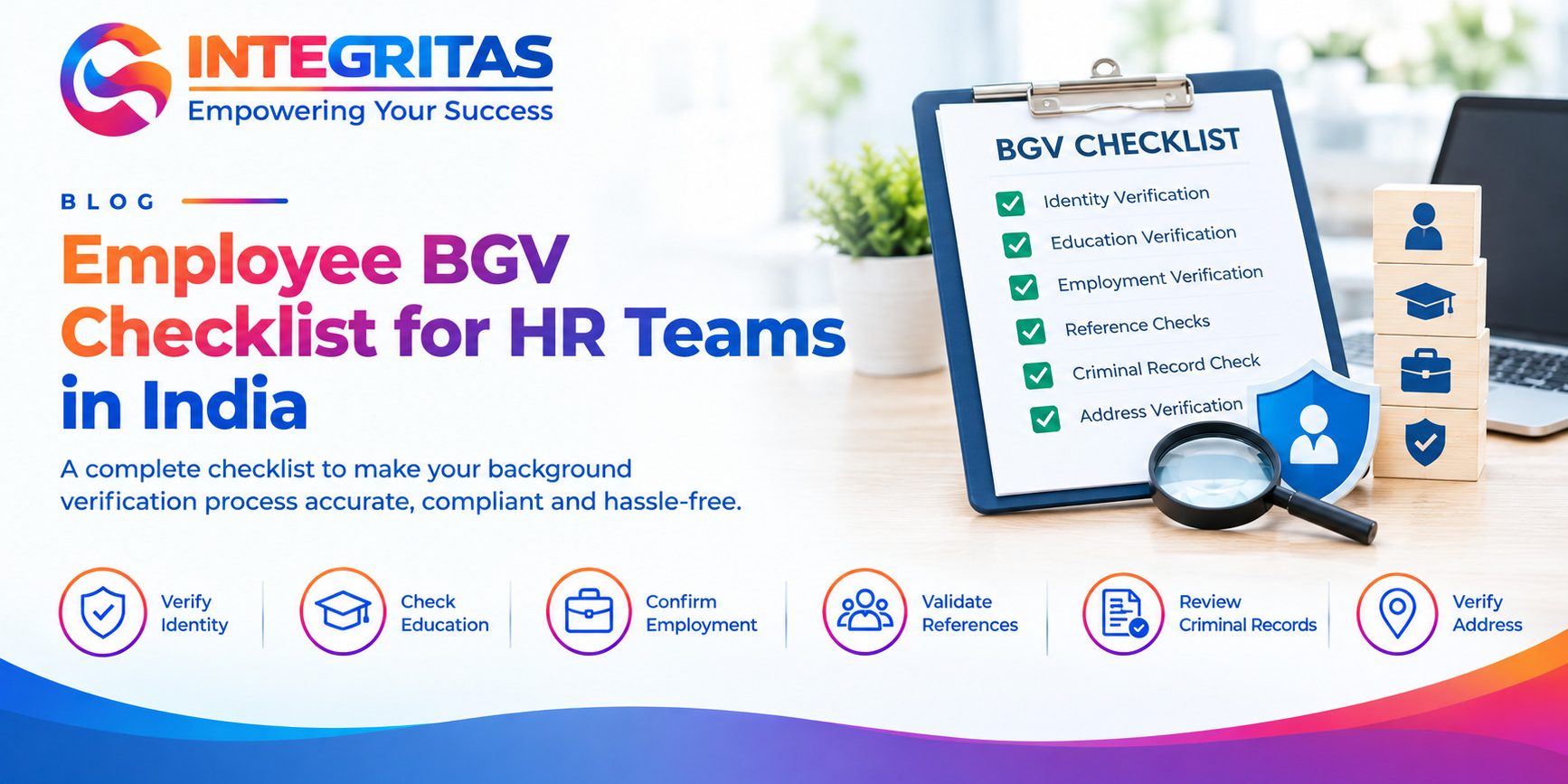
A single wrong hire can cost an Indian employer months of lost productivity, compliance trouble, and reputational damage. That is why bgv checks have moved from an optional formality to a core part of hiring. This checklist walks HR teams through every step of background verification, from identity to criminal records, so no candidate joins unverified.
What Are BGV Checks and Why Do HR Teams in India Need Them?
BGV checks are structured verifications of a candidate’s identity, employment, education, address, and legal history before or just after hiring. HR teams need them because resume fraud, fake degrees, and undisclosed legal issues are common hiring risks in India.
BGV stands for background verification. Some people use “background checks” and “background verification” interchangeably, and in everyday HR conversations they mean the same thing: confirming that what a candidate claims is true, using independent and authorised sources.
India’s hiring market is large, fast-moving, and highly mobile. Candidates switch cities, industries, and employers frequently, which makes self-reported information hard to trust at face value. Without bgv checks, HR teams rely on resumes and interviews alone, and neither can detect a forged experience letter or an inflated designation.
Reliable background verification protects more than the hiring decision. It protects customer data, company assets, workplace safety, and the employer brand. In regulated sectors such as banking, insurance, healthcare, and education, it also supports compliance and audit readiness.
What Does a Complete Employee BGV Checklist Include?
A complete employee BGV checklist covers identity, employment, education, address, criminal history, and reference checks as the baseline. Role-specific add-ons include credit, global database, dual employment, UAN, gap, and social media checks.
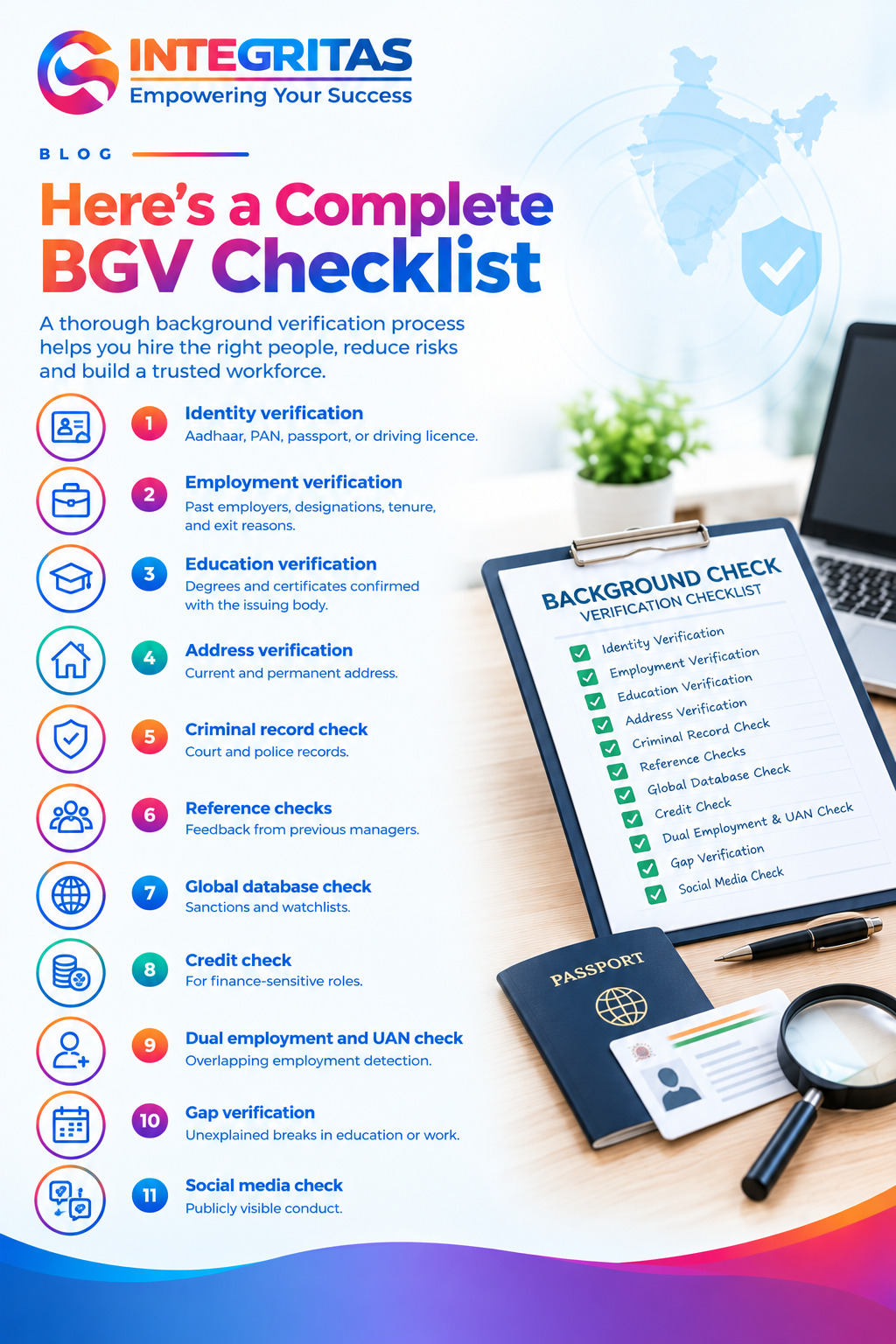
Here is the checklist at a glance:
- Identity verification: Aadhaar, PAN, passport, or driving licence
- Employment verification: past employers, designations, tenure, and exit reasons
- Education verification: degrees and certificates confirmed with the issuing body
- Address verification: current and permanent address
- Criminal record check: court and police records
- Reference checks: feedback from previous managers
- Global database check: sanctions and watchlists
- Credit check: for finance-sensitive roles
- Dual employment and UAN check: overlapping employment detection
- Gap verification: unexplained breaks in education or work
- Social media check: publicly visible conduct
Not every candidate needs every item. The best HR teams define BGV checks by role risk, not by habit. A fresher joining a support team does not carry the same risk as a finance manager who approves payments or an IT engineer with access to customer data. Treating both the same either wastes budget on over-screening or leaves critical roles exposed. A simple way to decide is to ask three questions for every role: Does this person handle money, data, or customers? Do they work independently or in a position of trust? Is the role regulated by law or by client contracts? The more “yes” answers, the deeper your background verification should go. Document this logic in a written screening policy so every hire is treated consistently and your decisions hold up in an audit or dispute. The sections below explain each check, what it confirms, and when it makes sense to include it.
How Do You Verify a Candidate’s Identity?
Identity verification confirms that the candidate is who they claim to be, using government-issued documents such as Aadhaar, PAN, passport, or driving licence. It is the foundation of all other bgv checks.
If identity fails, every other check becomes unreliable. A forged or borrowed identity can let an unfit person into a role with access to money, data, or customers.
HR teams should collect clear copies of at least two valid identity documents and cross-check name, date of birth, and photograph for consistency. Digital verification against official sources is faster and more accurate than manual review. Use only as much identity data as you actually need, and always collect it with the candidate’s informed consent.
How Do You Verify Employment History?
Employment verification confirms a candidate’s previous job titles, joining and exit dates, responsibilities, and reason for leaving by contacting former employers or cross-referencing official records such as UAN data.
This is among the most important bgv checks because experience claims drive salary, designation, and trust. Common red flags include inflated tenure, upgraded job titles, fabricated companies, and fake relieving letters.
A strong process includes:
- Verifying directly with the previous employer’s HR, not with a number supplied by the candidate
- Cross-checking against EPFO (UAN) records where available
- Confirming designation, last drawn compensation range where permitted, and eligibility for rehire
- Documenting alternate sources when a former employer is unresponsive, closed, or too small to have formal HR
Employment verification is also your best defence against candidates who hide short stints or terminations.
How Do You Verify Education Credentials?
Education verification confirms degrees, diplomas, and certificates directly with the issuing university, board, or institution, and checks that the institution is recognised.
Fake degrees and unrecognised institutions remain a real problem in India. Education verification protects you from hiring underqualified candidates for technical, regulated, or senior positions.
Verify the following:
- Name of the institution and the university or board it is affiliated with
- Course name, year of passing, and roll number
- Mode of study (regular, distance, or part-time)
- Recognition of the institution by relevant regulators such as UGC or AICTE, where applicable
For roles requiring professional licences, such as chartered accountants, doctors, or engineers, also verify membership or registration with the relevant professional body.
Why Is Address Verification Part of BGV Checks?
Address verification confirms where a candidate actually lives, through a physical field visit or verified digital methods. It strengthens identity validation and helps employers reach the employee when needed.
Address checks matter most for field roles, delivery and logistics staff, drivers, and employees handling company assets. A mismatch between the declared and actual address may point to an identity problem or an unstable background.
Most background verification providers check both the current and permanent address. Digital address verification, such as location-based confirmation with consent, can shorten turnaround time compared with traditional field visits.
Are Criminal Record Checks Necessary for Every Hire?
Criminal record checks are not necessary for every hire, but they are strongly recommended for roles involving money, data, customers, children, or safety. They review court records and police verification for undisclosed legal matters.
In sectors such as BFSI, healthcare, education, security, and cab or logistics services, criminal checks are often considered non-negotiable. For other roles, the decision should rest on risk.
Handle results with care. A record is not automatic disqualification. HR should consider the nature of the offence, how recent it was, its relevance to the role, and whether the candidate disclosed it. Always apply a consistent, documented policy so decisions are defensible and fair.
How Useful Are Reference Checks?
Reference checks gather qualitative feedback from former managers or colleagues about a candidate’s performance, conduct, and reliability. They add context that documents cannot provide.
Documents confirm facts, but references reveal behaviour: teamwork, attendance, integrity, and reason for leaving. For senior and leadership hires, reference checks are among the most valuable bgv checks.
Make them effective by:
- Speaking to supervisors, not just peers
- Asking consistent, role-relevant questions
- Cross-verifying references against employment records
- Treating unusually vague or overly positive feedback with caution
Which Additional BGV Checks Should HR Teams Consider?
Beyond the core checklist, HR teams should consider global databases, credit, dual employment, UAN, employment gap, and social media checks, depending on role risk and industry.
Global database check
Screens names against international sanctions lists and regulatory watchlists. It is useful for companies with global clients or compliance obligations.
Social media check
Reviews publicly available content for conduct that conflicts with the role. It should be limited to public information and handled with sensitivity.
Dual employment check
Detects whether a candidate is working full-time elsewhere. This has become more relevant with remote and hybrid work.
UAN verification
Uses provident fund records to validate employment dates and spot overlaps.
Gap verification
Examines breaks in education or employment so that timelines are complete and credible.
Credit check
Reviews financial discipline for roles that handle funds, such as accounting, banking, and senior finance.
How Does Consent Work in Background Checks Under Indian Law?
Candidate consent is essential before running any background verification. Under India’s Digital Personal Data Protection (DPDP) Act, 2023, employers should collect only necessary personal data, for a stated purpose, with clear consent.
Consent-first practice protects both the candidate and the employer. In practice, HR teams should:
- Take written or digital consent before initiating bgv checks
- Explain which checks will be run and why
- Collect only the data needed for the role
- Store candidate data securely and delete it when it is no longer needed
- Choose a verification partner that follows documented, DPDP-aligned practices
What Is the Step-by-Step Background Verification Process?
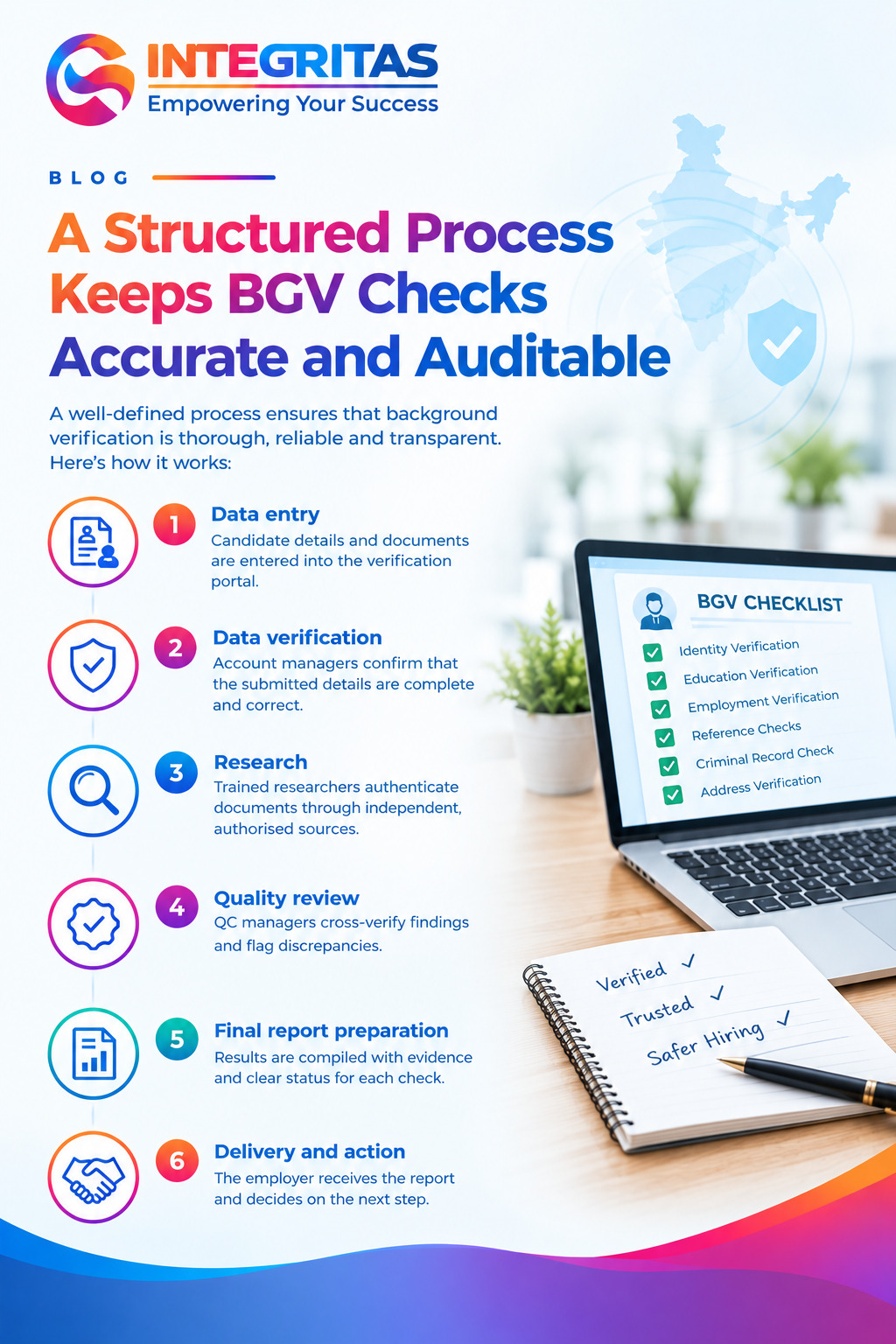
The background verification process typically runs through six stages: data entry, data verification, research, quality review, final report preparation, and delivery to the employer.
A structured process keeps bgv checks accurate and auditable:
- Data entry: Candidate details and documents are entered into the verification portal. Clean, complete input at this stage prevents delays later, so HR should share full names, dates of birth, previous employer details, and legible document copies upfront.
- Data verification: Account managers confirm that the submitted details are complete and correct. They catch spelling mismatches, missing documents, and incomplete employer contacts before research begins, which saves time and avoids rework.
- Research: Trained researchers authenticate documents through independent, authorised sources. This includes contacting universities, former employers, court databases, and official records rather than relying on candidate-supplied contacts.
- Quality review: QC managers cross-verify findings and flag discrepancies. A second pair of eyes ensures that errors, inconsistencies, and borderline cases are examined before anything reaches the client.
- Final report preparation: Results are compiled with evidence and a clear status for each check. A good report explains what was verified, how, and what any discrepancy means, so HR does not have to guess.
- Delivery and action: The employer receives the report and decides on the next step. This is where HR applies its screening policy, discusses any discrepancy with the candidate, and records the final decision.
Turnaround depends on how many checks are involved and how quickly institutions and former employers respond. Many providers complete standard packages within a few working days, though complex or field-based checks can take longer.
What Mistakes Should HR Teams Avoid?
The most common mistakes are verifying after the candidate has already joined, skipping consent, applying checks inconsistently, and treating every discrepancy as fraud.
Watch out for these:
- Starting late: Initiate bgv checks at offer stage, not weeks after onboarding.
- Inconsistent policy: Screening some hires deeply and others not at all creates legal and fairness risk.
- Ignoring small discrepancies: Minor date mismatches may be harmless, but patterns matter.
- Overreacting: A discrepancy needs context. Give candidates a chance to explain.
- Poor documentation: Keep consent forms, reports, and decisions on record.
- Choosing on price alone: The cheapest vendor can mean slow reports, weak sources, and compliance gaps.
How Do You Choose a Background Verification Company?
Choose a background verification company based on its industry experience, range of checks, technology, compliance discipline, and transparent reporting, not price alone.
Look for these qualities:
- Breadth of checks: One partner for identity, employment, education, criminal, address, and global checks keeps reporting consistent.
- Technology and accuracy: Digital workflows, automated tracking, and document-review tools catch forgeries faster.
- Compliance: Consent-driven processes aligned with the DPDP Act and clear data-handling policies.
- Turnaround and communication: Predictable timelines and responsive support.
- Report quality: Reports that explain discrepancies with context, not just a pass or fail.
- Customisation: Packages tailored to your roles and industry rather than a fixed template.
Providers such as Integritas offer end-to-end employee background verification with a structured six-stage process and role-based packages, which helps HR teams scale bgv checks without building the capability in-house.
How Does Integritas Help HR Teams Run BGV Checks in India?
Integritas is a background verification company in India that helps employers run accurate, consent-based BGV checks through a structured six-stage process. It has over seven years of experience in employee background verification and serves HR teams across major business hubs.
Integritas works as an extension of your HR team. Instead of chasing universities, former employers, and court records yourself, you share the candidate details and consent, and the Integritas team handles research, quality review, and reporting. That means faster, more consistent bgv checks without building a verification team in-house.
Which BGV checks does Integritas cover?
Integritas covers the full employee BGV checklist discussed in this guide:
- Identity verification
- Employment verification
- Education verification
- Address verification
- Criminal history check
- Reference checks
- Global database check
- Credit check
- Dual employment and moonlighting check
- UAN and employment gap verification
- Resume verification
Packages are customised to the role and industry. A BFSI hire, a BPO agent, and a logistics driver do not carry the same risk, so their background checks should not look the same.
Need reliable BGV checks for your next hire? Contact Integritas today for a customised background verification package.
FAQ’s
What are BGV checks in India?
BGV checks are verifications of a candidate’s identity, employment history, education, address, and criminal record before or soon after hiring. Employers use them to confirm that a candidate’s claims are accurate.
Are BGV checks mandatory for employees in India?
No single law requires BGV checks for all employers. However, many regulated sectors such as banking, healthcare, and security expect or require them, and many companies make them part of hiring policy.
How long do BGV checks take?
Timelines vary with the number and type of checks, plus how fast institutions respond. Basic packages often finish in a few working days, while field visits and international checks take longer.
What documents do candidates need for background verification?
Typically, identity proof (such as Aadhaar or PAN), education certificates, previous employment letters, relieving letters, recent payslips, and address proof.
What happens if a BGV report shows a discrepancy?
HR should review the details, give the candidate a chance to explain, and judge the discrepancy against the role. Minor errors differ from deliberate misrepresentation.
Can background verification be done after joining?
Yes, but it is better to start at the offer stage. Verification after joining leaves risk exposure during the review period and can complicate decisions if issues appear.
Do BGV checks cover freshers?
Yes. For freshers, the focus is on identity, education, address, and sometimes internships or references, since they have little employment history.
Is it legal to run social media checks on candidates?
Reviewing publicly available information with the candidate’s knowledge is generally acceptable, but employers should stay role-relevant and avoid intrusive or discriminatory use. Check with legal counsel for your situation.
What is the difference between background checks and background verification?
In everyday use they mean the same thing. Some professionals use “screening” for broader risk assessment and “verification” for confirming specific claims.
Should small companies and startups run BGV checks?
Yes. Smaller teams are often hit hardest by a bad hire, so even a lean package of identity, education, and employment checks is worth having.