Hiring in India has become faster, more competitive, and far more digital than it was even five years ago. Companies are reviewing larger volumes of applications, competing for specialised talent, and hiring candidates who studied across different cities, states, or even countries. In this environment, checking a resume alone is no longer enough to confirm that a candidate’s academic claims are genuine.
Credential discrepancies and misrepresentation can create significant hiring risks for employers. Inflated degrees, altered mark sheets, and fabricated certificates can surface across industries and job levels, not just in a few isolated cases. This is exactly why education verification has become such an important part of modern hiring.
Education verification adds a layer of assurance to every hiring decision. It confirms that a candidate’s degree, diploma, or certification is real, and it helps HR teams catch inconsistencies before they turn into bigger problems down the line. This guide explains what education verification is, why it matters, how the process works, and what employers should know about running effective employee education verification in India.
What Is Education Verification?
Education verification is the process of confirming whether a candidate’s academic qualifications are genuine and accurately presented. In simple terms, it answers one basic question: was this degree or certificate actually issued by the institution named, to this specific person?
For most employers, education verification has become a standard part of the hiring and due-diligence process, alongside identity, employment, and address checks. It is not just about spotting outright fake degrees; it also covers smaller inconsistencies, such as incorrect graduation years, mismatched course names, or degrees from institutions that are not recognised or approved by the relevant authority.
Why Education Verification Matters for Employers
Every hiring decision shapes an organisation’s future. A new employee affects productivity, workplace culture, client trust, and in some cases, regulatory compliance. While interviews and skill assessments help HR teams judge a candidate’s ability, they cannot confirm whether the qualifications listed on a resume are accurate. This gap is exactly why employee education verification has become essential for serious hiring processes.
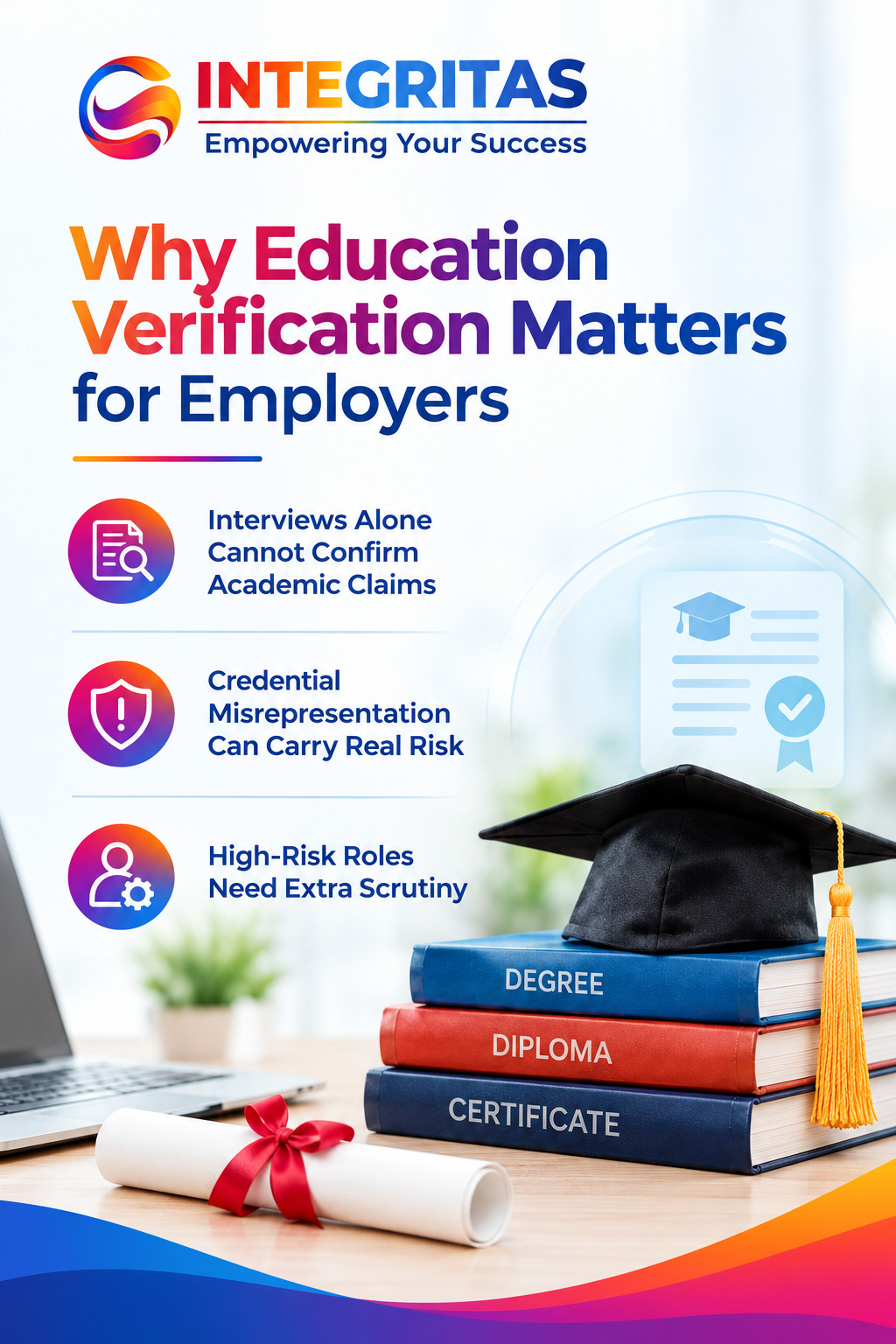
Interviews Alone Cannot Confirm Academic Claims
Interviews are useful for assessing communication, problem-solving, and technical knowledge, but they were never designed to confirm whether a degree is real. A candidate can speak confidently about their education and still be presenting a fabricated or exaggerated qualification. Structured education verification closes this gap by validating credentials directly with the issuing institution.
Credential Misrepresentation Can Carry Real Risk
Resume discrepancies related to education are not always obvious at a glance. They can include overstated degrees, incorrect completion dates, or mismatched specialisations across sectors and experience levels. These issues are rarely visible during a quick resume scan, which is why a structured bgv verification process is necessary rather than optional.
High-Risk Roles Need Extra Scrutiny
In sectors like healthcare, banking and financial services, and education itself, academic qualifications often determine whether a candidate is even eligible for a role. Hiring someone with unverified or fake credentials in these sectors can lead to compliance issues, legal risk, or safety concerns. This is why education verification carries extra weight for regulated and high-responsibility positions.
Beyond individual roles, consistent education verification also supports a fair and uniform hiring process, since every shortlisted candidate is assessed against the same verified facts. It helps employers avoid the cost of replacing a hire whose qualifications later prove inaccurate.
How Integritas Supports Education Verification for Employers
At Integritas, education verification is handled as a structured, multi-step process rather than a quick document check. Our education BGV services cover:
- Degree and diploma verification : Confirming that the qualification was genuinely awarded
- University and college verification: Validating enrolment, completion, and institutional standing
- Mark-sheet and transcript verification: Checking grades and academic records against source data
- International education verification: Validating foreign degrees and their recognition status in India
- Discrepancy identification: Flagging mismatches, gaps, or inconsistencies for HR review
- Document authenticity checks : Assessing certificates and transcripts for signs of tampering
- Employer-ready BGV reporting : A clear, well-documented reports that support confident hiring decisions
- Social media checks: Integritas also provide social media checks which offer valuable insight into candidate character and values.
We collect and validate candidate details, contact issuing institutions directly, cross-check available official databases, and review any discrepancies with context before sharing a final report. Our approach to employee education verification covers degrees, diplomas, and certifications from Indian and international institutions.
Whether you’re hiring for a single specialised role or running education verification across large hiring volumes, our team scopes the process to match the risk and requirements of the position, so you get accurate, well-documented results you can act on with confidence.
How Employee Education Verification Works: Step by Step
A well-run employee education verification process generally follows four clear stages.
Step 1: Document Collection and Data Validation
The process starts with collecting the candidate’s academic documents and key details, including the degree or diploma certificate, mark sheets or transcripts, the name of the university or board, the year of completion, and the specific course or specialisation. Small errors such as a misspelled name, a wrong date, or an incorrect course title can affect the accuracy of the entire verification, so this step needs care.
Step 2: Verifying With the Issuing Institution
Once the details are recorded, a verification request is sent to the relevant university, college, school board, or certification body. The institution is asked to confirm whether the candidate was enrolled, completed the programme, and was actually awarded the qualification in question. Some institutions respond digitally, while others still rely on manual record checks, which affects turnaround time.
Step 3: Cross-Checking Official Databases
Where digital records exist, official databases and registries are also reviewed to confirm whether the institution is properly recognised, whether the qualification genuinely exists, and whether the academic details are consistent. Since not every institution maintains complete online records, this step is usually combined with direct verification rather than used on its own.
Step 4: Reviewing and Flagging Discrepancies
Any inconsistencies found during the process are reviewed and categorised as a data mismatch, an unverifiable record, a negative verification where institutional records don’t match, or signs of a tampered document. This structured review gives HR teams a clear picture of the issue instead of a vague, unexplained result.
Common Types of Education Fraud
Irregularities in academic credentials appear in several forms. Some are obvious, while others only surface once a proper education background verification is carried out.
- Fake degrees: These are certificates that are entirely fabricated, or falsely linked to a real institution. They are often designed to closely resemble genuine documents, which makes them difficult to spot through appearance alone.
- Degrees from unrecognised institutions: In some cases, the qualification technically exists, but the issuing institution is not recognised or approved by the relevant regulatory authority. This can create a hidden risk, especially for roles that require a formally recognised degree.
- Exaggerated academic claims: Not every discrepancy involves a fake document. Candidates sometimes overstate their qualifications claiming a higher degree than they hold, changing their specialisation, or adjusting graduation timelines slightly to appear more experienced.
- Tampered mark sheets and transcripts: Academic records are occasionally altered to improve grades, hide gaps, or change personal details. These changes are usually impossible to detect through a simple visual check and require verification against the institution’s actual records.
These patterns make one thing clear: educational documents need independent validation. A structured degree verification process helps HR teams separate genuine qualifications from misleading ones, reducing avoidable hiring risk.
Handled properly, education verification works as a reliability filter for hiring, helping employers confirm academic claims, catch discrepancies early, and base decisions on verified facts rather than documents alone.
Common Challenges in Education Verification in India
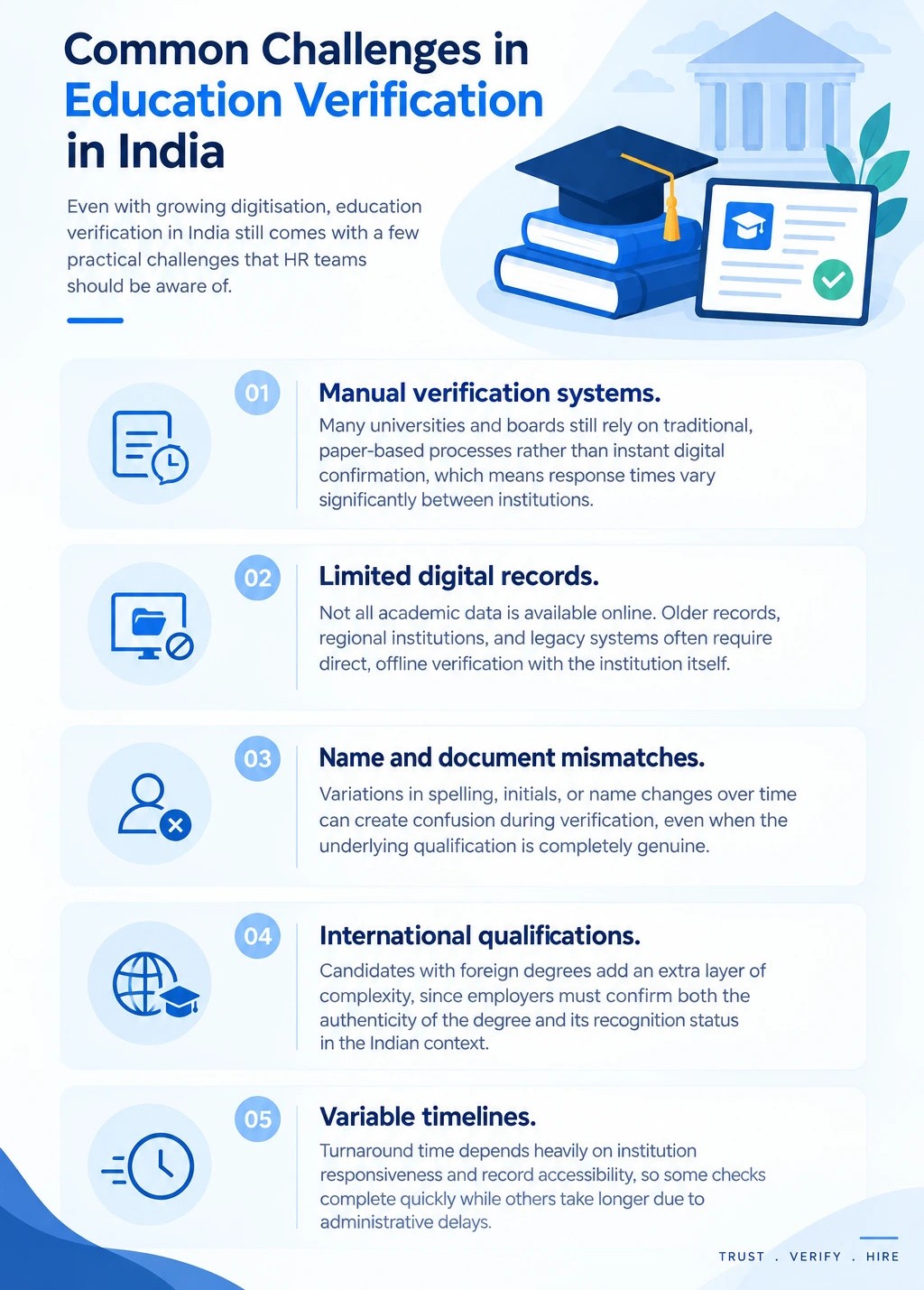
Even with growing digitisation, education verification in India still comes with a few practical challenges that HR teams should be aware of.
- Manual verification systems. Many universities and boards still rely on traditional, paper-based processes rather than instant digital confirmation, which means response times vary significantly between institutions.
- Limited digital records. Not all academic data is available online. Older records, regional institutions, and legacy systems often require direct, offline verification with the institution itself.
- Name and document mismatches. Variations in spelling, initials, or name changes over time can create confusion during verification, even when the underlying qualification is completely genuine.
- International qualifications. Candidates with foreign degrees add an extra layer of complexity, since employers must confirm both the authenticity of the degree and its recognition status in the Indian context.
- Variable timelines. Turnaround time depends heavily on institution responsiveness and record accessibility, so some checks complete quickly while others take longer due to administrative delays.
These challenges are exactly why a structured, experienced approach to employee education verification matters, it helps HR teams navigate these gaps without compromising on accuracy. A dedicated verification partner understands how different universities, boards, and regional institutions respond, and knows how to follow up when records are delayed or incomplete. This experience also helps resolve genuine name and document mismatches quickly, so a qualified candidate is not held up by a clerical variation. The result is a clearer, well-documented outcome that HR teams can rely on, along with a smoother hiring timeline and a better candidate experience.
FAQs’
What is education verification?
Education verification is the process of confirming that a candidate’s degree, diploma, or certificate is genuine and was actually issued by the institution they claim, rather than relying on the submitted documents alone.
How is employee education verification conducted in India?
It typically involves collecting the candidate’s academic documents, contacting the relevant institution directly to confirm enrolment and completion, cross-checking available official databases, and reviewing any discrepancies before a final report is shared.
What documents are needed for education verification?
Employers usually need copies of degree certificates, mark sheets or transcripts, enrolment or registration numbers, and any additional supporting documents the institution or verification partner requests.
Are online degrees verified the same way as traditional degrees?
Yes, the process still focuses on confirming that the issuing institution is properly recognised and that the qualification is genuine, whether it was earned online or through a traditional, in-person programme.
Can an education verification check result in a negative or adverse finding?
Yes, a check can result in a negative or adverse finding if there’s a mismatch between the submitted documents and institutional records, if the certificate is found to be forged, or if the degree comes from an institution that is not recognised or does not exist.
Need reliable education verification for your hiring process? Connect with Integritas to discuss your employee background verification requirements.